Posted in 21st Century Learning, digital citizenship, digital citizenship minute, digital learning, educating digital natives, parents and technology

5 Digital Citizenship Moments: Adult Conversational Digressions for Kids

You have just shared several websites and take a moment to comment to children about digital footprints. Or perhaps you sent an e-mail that you wish you had not sent and you mention that it’s not possible to get something back once it’s sent out electronically. Maybe you open a website of poor quality and point out one or two things that could be improved.

These are moments, each probably less than a minute of conversational digression, that reinforce the digital citizenship habits of children. These comments can be incorporated into any discussion or lesson.

Each time adults comment on digital citizenship issues in the context of daily lessons and classroom life, we model a kind of digital intelligence that students can emulate and embrace, whether they are working or playing.

When educators and parents make time for digital digressions, moments of digital citizenship addressing crucial issues, they informally incorporate  behavioral values that are a part of 21st Century connected learning. More importantly, these moments allow children to observe that just about every digital activity incorporates time-tested values such as careful evaluation, respect, collaboration, and inclusiveness.

Five Digital Citizenship Moments to Incorporate into Any Conversation

1. Pause for a moment whenever you use a web site, and explain one or two things that you like about it (or don’t like). Or explain just how you found the website.

Continue reading “5 Digital Citizenship Moments: Adult Conversational Digressions for Kids”

Posted in 21st Century Learning, digital devices, digital devices and gadgets, digital kids, teaching, teens and technology, wireless gadgets

New Pew Report on Teens and Technology 2013

Growing internet use by teens and other age groups, too.

If you are an educator who teaches teenagers or a parent of adolescents, check out this newest research release — Teens and Technology, 2013 —  from the Pew Internet and American Life Project. The survey results come from interviews with 802 adolescents between the age of 12 – 17 and separate interviews with their parents, conducted over the phone in English and Spanish.

If you have any doubts about how fast digital life is changing for young people, this should dispel many of them.

  • 78% of teens now have a cell phone, and almost half (47%) of them own smartphones. That translates into 37% of all teens who have smartphones, up from just 23% in 2011.
  • 23% of teens have a tablet computer, a level comparable to the general adult population.
  • 95% of teens use the internet.
  • 93% of teens have a computer or have access to one at home. Seven in ten (71%) teens with home computer access say the laptop or desktop they use most often is one they share with other family members.
  • 25% say they mostly use their phone online.

Most Interesting Quote

One in four teens are “cell-mostly” internet users, who say they mostly go online using their phone and not using some other device such as a desktop or laptop computer.

Schools must find ways to incorporate phones into the 21 Century learning paradigm.

Posted in 21st Century Learning, collaboration, digital kids, digital parenting, extreme professional development, NAIS Conference Reports, parents and technology

Workshop Planning As Extreme Professional Development: My NAIS Conference #3

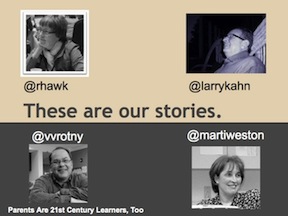
OurStoriesI’ve just returned from the 2013 National Association of Independent Schools (NAIS) annual conference, where I presented a workshop with three colleagues, Renee Hawkins, Vinnie Vrotny, and Larry Kahn. In our Thursday afternoon session we shared our ideas about coaching the parents of 21st Century learners to help them understand more about the digital lives of their children.

As I reflect on our wonderfully collaborative NAIS presentation project — coming up with an idea and developing it over time — I now understand that the workshop planning process led me and my colleagues on a substantial journey featuring what I think of as extremely connected professional development.

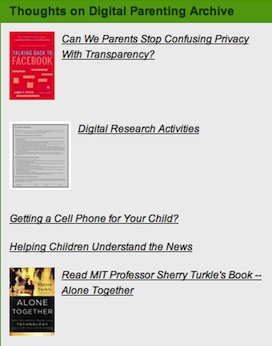
Thoughts on Digital Parenting
An example of digital parenting book resources

This workshop’s journey began a year ago at EdCampSeattle, where I shared an idea about the importance of educating 21st Century parents. At my school I work hard at educating parents about their digital kids, so I wanted to learn lots more about what my colleagues do at other schools.

Actually, I initially shared my idea with independent school colleague, Liz Davis, a dedicated EdCamp advocate, and she told me that I just had to attend EdCampSeattle. (Note: Liz is also one of the main people responsible for getting me to start blogging, but that’s another story.)

If you’ve attended EdCamp, you know that participants suggest lots of great ideas, but not everyone becomes part of the program. At the beginning of every EdCamp people walk around the room suggesting and choosing the topics they are most interested in — called the “law of two feet” in “EdCampSpeak.” They go on to experience, a day-long collegial event that they have planned, essentially carrying out their own program — in itself extreme professional development. Expanding this idea, my workshop colleague, Larry Kahn, will shortly experiment with inviting parents to attend an EdCamp along with teachers.

Continue reading “Workshop Planning As Extreme Professional Development: My NAIS Conference #3”

Posted in 21st Century Learning, assessing learning, digital learning resources, e-portfolios, electronic portfolios, NAIS Conference Reports, parents and technology, teaching digital kids

Getting Started With Electronic Portfolios: My NAIS Conference #2

You do not always expect the first workshop, on the first day of a conference to be a slam-dunk, but my 8:00 A.M. Thursday morning session was awesome.

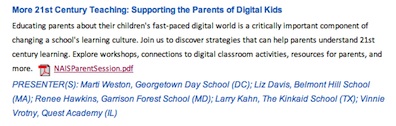
Check out the online presenters' resources.
Check out the online presenters’ resources.

Every bit of information that I collected at the Garrison Forest School workshop on electronic portfolios, presented at the National Association of Independent Schools (NAIS) annual conference in Philadelphia, will help me start an e-portfolio project at my school. As the four presenters shared their many resources and described their electronic portfolio research, my mind zoomed ahead to my return to school — all this before the end of the first hour of the conference.

I’ve been thinking about helping teachers and students create e-portfolios for some time, but with so many factors to consider and so much to figure out, I’m always a bit stumped when I think about the extensive collaboration that needs to take place. The benefits for teachers, students, and parents are clear, but the process takes an enormous amount of time to plan and carry out, and time is always at a premium. Yet we all know that twenty-first Century learners need to be able to think about, examine, evaluate, and extend their work if they are to be, well — better 21st Century learners. E-portfolios support this learning process.

Interestingly, about two weeks before this conference, two teaching teams that I support indicated – out of the blue — their interest in developing some sort of electronic portfolio project, so I am fortunate to have a small group of educators who want to get started. This workshop has essentially handed me the knowledge as well as a map to lead me.

Continue reading “Getting Started With Electronic Portfolios: My NAIS Conference #2”

Posted in 21st Century Learning, digital citizenship, digital kids, digital learning, digital parenting, NAIS Conference Reports, parents and technology, social media, social media friends

Learning Lots More About Topics I Know Lots About: My NAIS 2013 Conference #1

You are in a good workshop when it’s on a topic that you know well, and you end up learning a whole lot more, and when you feel new knowledge pathways opening up, you say “Wow!”  That’s what happened to me on Friday morning at the 2013 National Association of Independent Schools (NAIS) annual conference, this year in Philadelphia.

I attended a workshop, “It’s Just Facebook: Ethical Questions in Social Media Use,” and discovered first-hand how much I can still learn about educating children, their parents, and educators when it comes to 21st Century digital citizenship and media literacy problem-solving. What’s  especially interesting to me since, just the day before, I presented a workshop with three of my NAIS colleagues on a similar topic.

Ethics institute
Check out the Ethics Institute teacher workshops.

In their “Ethical Questions” workshop, Kent Place School presenters Kimberly Coelho and Karen Rezach helped us compare moral with ethical dilemmas sharing case studies that are designed to help students examine and address the life challenges that pop up in their 21st Century learning and digital lives.

The two leaders, part of the Ethics Institute at Kent Place, walked us through the discussion process, emphasizing how they  include a range of different perspectives. Often right and wrong answers are not so clear because the dilemmas usually present competing values, so the problems are not examined or solved easily.

Continue reading “Learning Lots More About Topics I Know Lots About: My NAIS 2013 Conference #1”

Posted in 21st Century Learning, communicating with grandparents, digital parenting, family conversations, grandparents, intention versus consequence, parents and technology, teaching digital kids

Whose Eyes Are Checking Out That Digital Content?

In his recent post over at the Changing Aging blog, Kavan Peterson describes a short video, Forwarders. Intended as a parody of people who continuously forward e-mail, the video reinforces stereotypes about elders and aging. It’s sad that this short film focuses solely on one older adult, especially since so many people of all ages are extreme (and irritating) forwarders.

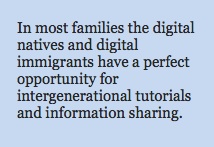
generational tutorialsWhile it’s intended to be funny, the video’s other message is that old people with wrinkles are silly and inept — at least that’s my interpretation. I’ll bet that the video producer — I am guessing an adolescent or young adult — probably cherishes a fair number of lifelong relationships with grandparents. This parody promotes a stereotype that could have been alleviated simply by adding in a few younger characters who also need reforming. (I posit a guess about the creator/producer’s age after looking over other published web content.)

The video and others like it also raise a question. How do we help 21st Century learners who are natural Internet content “whizzes” to understand that everything uploaded is subject to interpretation?

As a teacher who concentrates on educational technology, I frequently hear the refrain, “But I did not mean to hurt that person,” usually after a student has created and uploaded what he or she considered to be amusing content. Sometimes it is, sometimes it isn’t, and sometimes various readers or viewers interpret the message differently. What my students slowly learn is that digital content may be funny to one person, not funny to another, and for some individuals downright insulting.

In today’s connected society digital natives — born into a world of computers, cell phones, and various other gadgets — find it easy to create content, but sometimes they forget that what they do and say (and upload) circulates far and wide. Different people will watch and may reach different conclusions about the work. One person’s joke can unintentionally malign others. Humor that is appropriate for a person at one age is not so funny when it’s uploaded into the world at large for everyone to see. Digital natives need to learn and respect the ways that different people view the world through slightly different lenses. Most professional writers of parody think long and hard about every detail of a project, interchanging those lenses as they create.

Continue reading “Whose Eyes Are Checking Out That Digital Content?”

Posted in 21st Century Learning, Bookmark It!, digital learning resources, educating digital natives, parents and technology

Grammar Girl Podcasts – Listen and Learn!

Just about every day I have a grammar question, despite that in junior high school I was an ace at diagramming sentences. Most commonly I need to figure out how to punctuate something I have written. I search for an answer, and I want to remember the information — if possible — so that I can use it the next time the same question arises. Yes, I could consult The Elements of StyleOn Writing WellThe Chicago Manual of Style, or countless other good grammar books.

grammargirl
Visit Grammar Girl!

These days, however, when I am puzzling over a comma or a particular word, I almost always go online to find a podcast at Grammar Girl’s Quick and Dirty TipsI listen to the explanation, usually accompanied by music and amusing examples, and even days later I still remember the rule or the spelling or usage — even if the topic has not reappeared in my writing.

If you have not checked out the Grammar Girl podcasts, take some time to do so. They are great fun — two words that I never associated with sentence diagrams.

Continue reading “Grammar Girl Podcasts – Listen and Learn!”