Posted in 21st Century Learning, digital citizenship, digital learning, digital learning resources, educating digital natives, online learning

Action Words that Describe Digital World Learning

digital-citizenship Can we teach pre-adolescents and teens to reflect on what’s happening as they use digital world tools and interact with online content? Can we help them understand more about what they are doing when they work and play online?

Educators often provide a checklist or rubric for students to use as they work on assignments or projects. A rubric usually contains editing specifications, project requirements, resource documentation, and expectations — all for students to consider while completing the work.

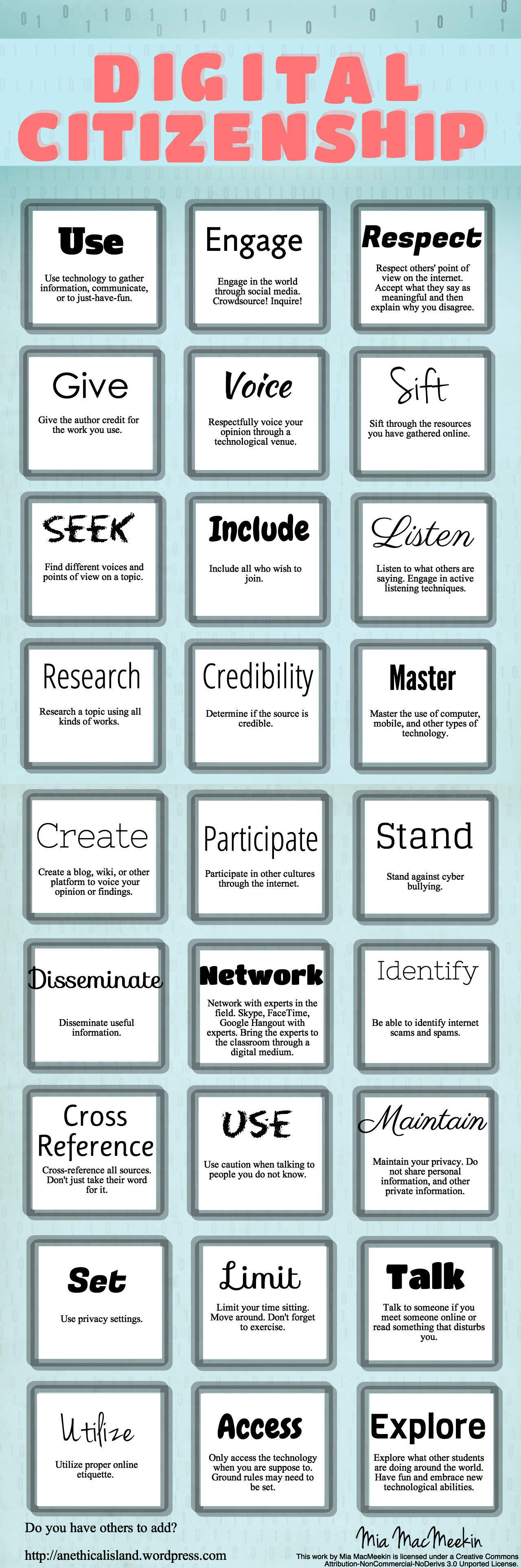
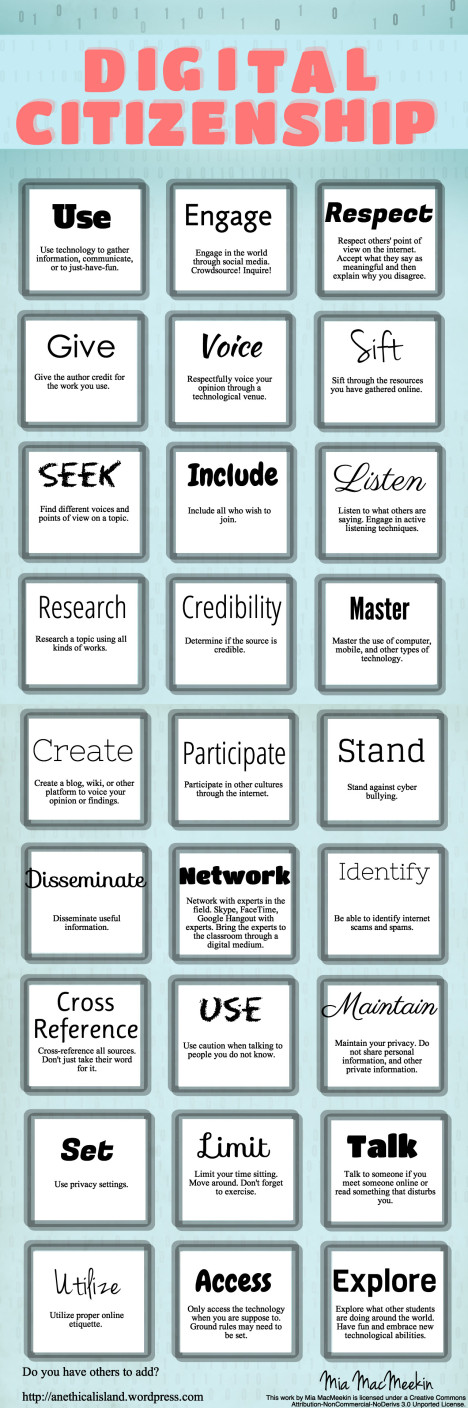
Now I’ve discovered that Mia MacMeekin over at the An Ethical Island blog offers what I think of as a digital learning graphical rubric. The easy-to-understand graphic features World Wide Web nouns and action verbs that describe the ways people encounter, process, and use online information. MacMeekin thinks of her infographic as a digital citizenship tool, but it’s much more than that. The chart offers educators with opportunities to ask questions as they teach, and more importantly, expect students to answer them.          Continue reading “Action Words that Describe Digital World Learning”

Posted in 21st Century Learning, 21st Century parenting, digital learning, diversity, parents and technology, reading on the web

The International Children’s Digital Library (ICDL): Changing the World One Book at a Time

What if our children had instant access to a library with thousands of books from countries all over the world — a place that invited them to drop by, read, and learn about one another (without any driving)? Imagine what they could find out about the world’s cultures, celebrations, languages, differences, and also about what they have in common  with all these other people and places!

That just about describes the mission of the International Children’s Digital Library (ICDL), a World Wide Web destination hosted at the University of Maryland. The massive website includes digitized books in 61 languages, and it’s the largest online collection of multicultural children’s literature with a mission to the promote the love of reading AND the love of diversity. The books are beautiful filled with colorful and detailed illustrations — you almost feel like you are holding an old-fashioned book!

By clicking on the animated Read Books! icon in the middle of the ICDL home page readers, young and old, are off and reading. The multi-cultural aspect comes from interacting with books that are read and languages spoken by children in 42 other countries as well as seeing pictures by artists from around the world.      Continue reading “The International Children’s Digital Library (ICDL): Changing the World One Book at a Time”

Posted in 21st Century Learning, 21st Century parenting, digital citizenship, digital footprints, digital kids, digital learning, parents and technology

How We Teach Digital Citizenship Makes a Difference

Digital Citizenship Posters Become a Hallway Exhibit
Digital Citizenship Posters Become a Month Long Hallway Exhibit

When it comes to digital citizenship, we cannot just lecture or watch videos.

Everyone learns best by doing — whether it’s tying a shoe, mastering letter sounds, figuring out a science concept, learning to drive, parenting a new baby, or any other activity, including what we need to figure out on computers and digital devices. When people tell us how to do something by talking a lot, most of us can’t wait for the person to stop talking so we can try to do it ourselves.

Now consider how we have gone about teaching 21st Century children — at home and at school — about digital devices and digital world behavior. Mostly adults talk and talk, telling children, pre-adolescents, and teens about all the things that can go wrong and explaining what we don’t want them to do.

Over the past 15 years, I’ve spent way too much time talking to kids about digital life issues and not nearly enough time doing things with them. So these past few years I’ve changed the way I teach.                              Continue reading “How We Teach Digital Citizenship Makes a Difference”

Posted in 21st Century Learning, 21st Century teaching, connected learning, digital kids, digital learning, digital literacy, digital world conversations

Innovative Teaching: How on Earth Do We Get Started?

innovative teachersYears ago as a beginning teacher, I asked one of my University of Chicago professors how it was that my mentoring teacher seemed to do everything at once — teaching one group, keeping an eye on other parts of the classroom, and continuously but quietly communicating with everyone in the room — all at the same time. She even knew when a student some distance behind her was not completing the assigned task.

“She acquired those skills step-by-step,” my professor replied.

Today as we cope with the challenge of transforming our teaching skills to make what goes on in our classrooms applicable to the ever-changing world of digital information (a.k.a. innovation or 21st Century learning), many of us are renewing our commitment to lifelong learning as we explore and acquire a range of new skills and behaviors. We are learning, step-by-step, how to teach differently and stretch ourselves in ways that help students access, process, and use information in innovative but sensible ways.          Continue reading “Innovative Teaching: How on Earth Do We Get Started?”

Posted in 21st Century Learning, connected learning, parents and technology, Safer Internet Day

International Safer Internet Day – February 11, 2014

Parents and educators may want to encourage 21st Century learners to participate in the International Safer Internet Day celebration on February 11, 2014. This year I am especially looking forward to the event, because it focuses on what is good about the connected world. (Unfortunately, way too often people concentrate on the fear aspects of the connected world.)

One Good Thing
Instructions for Submitting a Video

Over 100 countries observe Safer Internet Day each year on a day in February. As a part of the celebration, United States organizers are asking participants to make short videos that share their thoughts about the good things that can happen on the Internet concentrating especially on how these good things contribute to making the world a better place.

The United States sponsors of the event are journalists Anne Collier and Larry Magid, who jointly run the ConnectSafely.org website. Anne also writes on her blog at NetFamilyNews.org and Larry writes on his at LarrysWorld.com.

Check out the U.S. Safer Internet Day website below.                  Continue reading “International Safer Internet Day – February 11, 2014”

Posted in 21st Century Learning, 21st Century parenting, kids changing lives, parents and technology

How Millennial Are You? Take this Pew Internet Quiz

How Millennial
Click to take the Pew Internet quiz.

I just discovered and took the quiz, How Millennial Are You? over at the Pew Internet Research Center website.

The questions cover digital-age habits such as reading newspapers, using mobile phones, and watching television, as well as a fair number of lifestyle issues. It’s interesting to do, and the score places each quiz-taker on a continuum with a range of generations from people in their 70s and above (called the silent generation) to boomers and down through millennials.

Once you answer the questions and get a score, it’s possible to change answers and see how the score changes. A quiz-taker can also look at graphs that depict how various generations of test takers fared in a more scientific survey.

This short exercise can help the parents of 21st Century kids develop a keener sense of how the behavior of various generations changes as digital life intensifies. Teachers may want to give the quiz a try because it can help them gain more insight into the lives of their 21st Century learners.

I scored 70, so I have a lot of digital-age millennial characteristics. On the other hand, despite the fact that my husband is digitally literate, he scored 30 (losing a lot of points for reading at least one newspaper each day and texting rarely). It was especially interesting to look at the graphs and see how we compare to other people in our age ranges.

Take the quiz, have fun, and learn.

Posted in 21st Century Learning, 21st Century teaching, connected learning, digital life, parents and technology

The 2013 Digital World? What CAN I Be Thankful For?

martipicTGiving
Happy Thanksgiving, everyone!

It’s Thanksgiving 2013, a time when we give thanks for family, friends, and the richness of our lives. It’s also a time to take stock, gain perhaps a bit more insight about the quality of life, and maybe even refrain from always wishing for more.

As a teacher, 21st Century learning advocate, and educational technology enthusiast, I spend much of the year on this blog suggesting ways that families, educators, children, and certainly, my students, can strategize, enrich, and improve their digitally connected lives and, of course, learn enough to avoid potential problems.

But today is different!

We spend so much time grumbling about all the problems that arise in our digital era. So to add some extra fun to our family’s Thanksgiving 2013 celebration, here are a few special experiences and joys that the digital world has brought into my family’s life — for which I am most grateful.

I am thankful that digital life allows me to:                  Continue reading “The 2013 Digital World? What CAN I Be Thankful For?”