Posted in digital citizenship, digital parenting, digital world conversations, electronic communication, family conversations, parent education, parents and technology, teaching digital kids

E-mail, Scandals, and Digital Footprints — AGAIN!

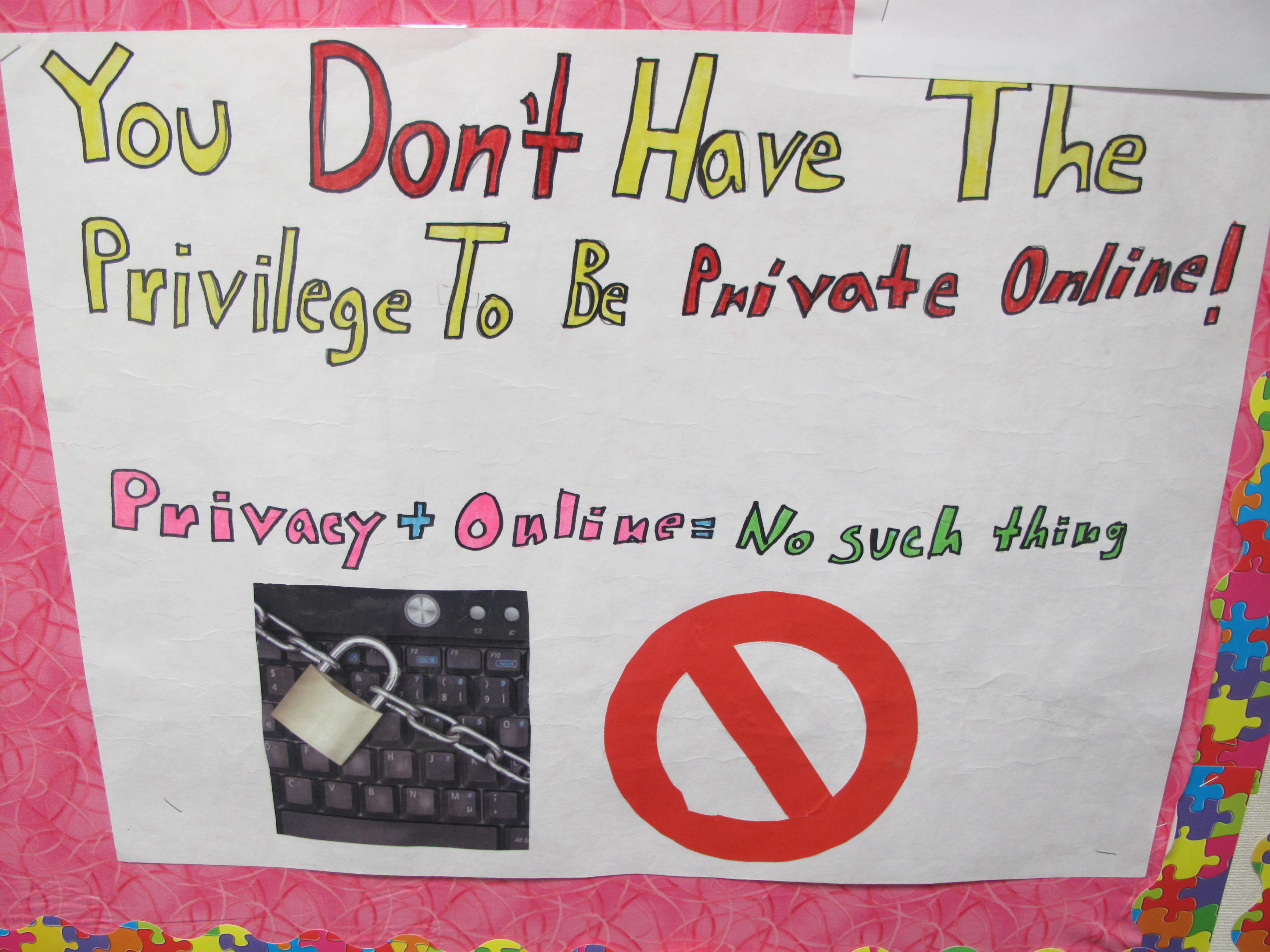
One of the digital citizenship posters made by my students a year or two ago.

On a fairly regular basis, a public scandal occurs, and these days just about every one of them reminds us of how ignorant people are about the transparency of their digital footprints.

If reading about the most recent scandal doesn’t convince you of how easily accessible digital footprints can be, then this November 17, 2012 Washington Post article should. In The FBI’s Long Reach Into Digital Lives, reporters Greg Miller and Ellen Nakashima describe how easily the FBI gets into an individual’s e-mails and how accessing one account leads to exploring the accounts of other people who have sent or received e-mails.

Interesting Quote from the Post Article

Investigators with a warrant to search a house for drugs can seize evidence of another crime… But the warrant does not allow them to barge into the house next door… But what are the comparable boundaries online? Does a warrant to search an e-mail account expose the communications of anyone who exchanged messages with the target?

Scandals arising from common digital mistakes can provide opportunities for adults and children to participate in family conversations, learning more about their online and networked world. However, if you do not want to talk about the scandal, that’s fine — talk about the lack of privacy that everyone experiences today. Children who make mistakes have no protection as they explore the digital world, because what they do can easily become public and embarrassing. In any past era their common and developmentally appropriate errors would mostly remain private, but with today’s speedy and electronic communication tools, that’s less and less likely.

We are not trying to scare children, but we are trying hard to make common sense second nature.
Continue reading “E-mail, Scandals, and Digital Footprints — AGAIN!”

Posted in 21st Century Learning, digital citizenship, digital parenting, online safety, parent child conversations, parents and technology, teaching digital kids

Seeking a Family Digital Use Agreement or Contract?

Check out the GetNetWise family digital use agreements.

Many times each year parents and teachers ask me for examples of agreements and contracts that can help families focus on digital life expectations and limits-setting. Some individuals seek a pre-written document to use with their children, while others hope to design and write a document expressly for their families.

These agreements, contracts, or pledges, cover the gamut of 21st Century digital world behavior, from cell phones, to online access, to texting, web 2.0, social media, cyber-bullying, and digital citizenship.

The conversation and preparation that contribute to developing a family agreement or contract are often more important than the final document. In these family discussions, parents will need to arm themselves with information about digital natives, address values, and encourage common sense. Parents will also need to help their children think about what to do in unexpected situations, and encourage them to speculate on how to cope with friends who encourage them to misbehave. The more personal and relevant the agreement, the better.

Then, too, adults should understand that the preparation and writing process is not a one-way street. A child may make a pointed observation or come up with a thoughtful idea about the digital issues contained in the agreement. Perhaps he or she feels strongly about certain types of access, time limits, or other parental expectation.  Maybe there are compelling reasons to grant access to one site or another, even though the parent has reservations.

Continue reading “Seeking a Family Digital Use Agreement or Contract?”

Posted in 21st Century Learning, digital citizenship, digital learning, evaluating web site resources, parents and technology

New Google Lessons: Understanding YouTube and Digital Citizenship

Visit the Google lessons site.

Check out the Google interactive lessons, videos, and slides, all focused on digital citizenship, privacy, and YouTube best practices. Useful for teachers as well as parents, these discrete units are easy to use and share, especially when students need an organizational framework before beginning to look for school project resources. Each lesson is readily downloadable as a Google Doc and even for other presentation media such as PowerPoint.

Many of the Google videos include tips that can help students use YouTube more effectively while honoring copyright principles and evaluating content carefully. Google developed these digital resources for secondary students, but in many schools, the videos will also be valuable for middle schoolers. Even fifth grade teachers may find that some of the videos can help them in the context of curriculum units.

A conundrum exists, of course…          Continue reading “New Google Lessons: Understanding YouTube and Digital Citizenship”

Posted in cyber-bullying, digital parenting, electronic communication, online safety, parents and technology, social media, social media friends, teens and technology

Good, Bad, Ugly… Internet? – Danah Boyd

Check out Danah Boyd’s short commentary, The Good, the Bad, the Ugly … and the Internet in Boston Magazine. In the June 15, 2012 piece Boyd describes how fears about children’s safety have curtailed their time out in the real, face-to-face world for several generations. Today many parents have transferred their fears into the digital world.

Read some of Boyd’s blog posts here.

Boyd points out that many serious behavioral issues, bullying, for instance, have been and continue to be huge problems. Yet they tend to be more frequent and serious face-to-face than in the digital world (though the digital problems get more media coverage). As one of the most well-regarded observers of teen social networking behavior, Boyd conducts research for Harvard’s Berkman Center and for Microsoft.

Continue reading “Good, Bad, Ugly… Internet? – Danah Boyd”

Posted in acceptable use, digital citizenship, digital parenting, online safety, parents and technology

Read 10 Simple Steps to Internet Safety at Common Sense Media

Check out 10 Simple Steps to Internet Safety over at the Common Sense Media website. Actually it looks like there are eleven items for parents to review at the page.

As always, Common Sense Media hits the nail on the head with clear, well written, and to-the-point parenting information. I’ve inserted a list of the questions.

Pay special attention to the two questions that I’ve listed below:

  • How do I teach my kids to recognize online advertising?
  • Should I let my kid get a Facebook page?
Posted in acceptable use, digital citizenship, digital footprints, kids changing lives, online communication, teaching digital kids

5 Digital Citizenship Moments for Your Classroom

Read my original post on digital citizenship minutes.

Each time teachers comment on digital citizenship issues in the context of daily lessons and classroom life, they model, as all adults should, a digital intelligence — just what we want our students to embrace, whether they are working or playing in the today’s world.

As educators pay increasing attention to these digital digressions throughout the school day, they demonstrate critical values of 21st Century learning — and life — in a networked world. But more importantly, our students observe that just about every learning activity these days, whether digital or not so digital, incorporates time-tested values such as thoughtful evaluation, respect, collaboration, inclusiveness, and acceptance.

Five Digital Citizenship Minutes to Incorporate into Any Lesson

1. Pause for a moment whenever you use a web site, and explain one or two things that you like about it (or don’t like). Or explain just how you found the website

2. Share an irritating or inconsiderate e-mail or cell phone moment — telling your students how it feels and why.

Continue reading “5 Digital Citizenship Moments for Your Classroom”

Posted in 21st Century Learning, digital citizenship minute, digital learning, digital world conversations, parents and technology, teaching digital kids

The Digital Citizenship Minute: Digital Digressions in the Classroom

Read the piece at NetFamilyNews.org.

A year ago I asked my fifth-graders to write podcast scripts. They wrote about teasing, cyberbullying, gossip, intention vs. consequence, advertising, digital footprints, and the lack of facial cues in electronic communication. Working mostly in collaborative groups, my students recorded complete “’casts” in our informal laptop studio.

As always when it comes to 21st Century learning, a few students improved upon my lesson plan and asked to write podcasts for their other teachers. The resulting efforts helped students refine their digital citizenship perspectives. One student noted, “When an electronic problem [like cyberbullying] becomes a ‘big problem,’ teachers talk about it at school. How come we don’t talk about these things when they aren’t [big] problems?”

Continue reading “The Digital Citizenship Minute: Digital Digressions in the Classroom”