Posted in acceptable use, digital citizenship, digital photography, parent child conversations, parents and technology, writing for the web

Conversations About Commenting

If you have ever written a comment at the end of an article or blog posting, you have surely read more than a few inappropriate and sometimes distasteful remarks. Sometimes people leave these comments anonymously. Posted by folks who do not understand why websites invite visitors to share thoughts and ideas, many unfiltered remarks are permanently attached to websites — indiscretions waiting for the whole world to discover.

Read a short post and watch a video on newspaper comments, uploaded by the Nieman Journalism Lab at Harvard. Some newspapers sites, such as the Boston Globe, post a short and succinct comment policy.

Helping your child avoid public website blunders is one reason to discuss commenting etiquette. Often children don’t know or forget that their comments leave a digital footprint trail that will last much longer than their per-adolescent and even teenage years.  Often confusion arises because many children first encounter commenting opportunities in places where adult supervision is scarce. As a result an impulsive idea can beat out good common sense even when a child knows better. Bottom line — response and commenting areas are not places to leave nasty, rude, and hateful conversation.

Continue reading “Conversations About Commenting”

Posted in digital parenting, parents and technology, when kids make mistakes

My Kid’s Digital Blunders? How to React?

updated 9-26-2011

At one time or another, most of us experience the protective parent surge, a not-my-child reaction, when someone lets us know that a son or daughter could be involved in some sort of digital misbehavior. Often a child’s digital blunder is public for many people, but not public enough for a  parent to casually discover the problem, so the first alert may indeed come from another parent.

Especially if this information comes from someone who is not well-known, the protective parent energy surge can complicate an issue even further. I know because I’ve felt this powerful surge.

Ages ago I heard a presentation that described how to react when one parent tells another parent that a child may be involved in a problem. I don’t remember when or where, but here are the seven rules I subsequently made for myself. Continue reading “My Kid’s Digital Blunders? How to React?”

Posted in digital parenting, Evaluating Web Resources, parents and technology, research on the web

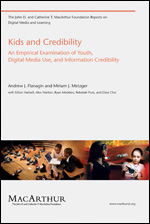
Kids and Web Credibility

Click for PDF of the book.

If you worry about the digital research activities of children, especially older students who complete significant amounts of their research using the unlimited resources available on the World Wide Web, you are not alone. Over the past 10 years I have wondered — more than once and sometimes with great angst — if my child and the many children I’ve known over the years really understand the need to evaluate the resources that they find on the web.

Recently I discovered a small book, published by the MacArthur Foundation, describing research that explored how children perceive the quality and reliability of digital media. It’s a book that concerned parents may want to read. In Kids and Credibility: An Empirical Examination of Youth, Digital Media Use, and Information Credibility, authors Andrew J. Flanagin and Miriam J. Metzger, summarize their study as a “…comprehensive investigation into youth’s Internet use and their assessment of the credibility of online information.” The authors wondered whether young digital media users, while sophisticated and fearless about using technology, could evaluate information and determine its quality. Continue reading “Kids and Web Credibility”

Posted in digital parenting, family conversations, parent child conversations, parents and technology, social networking

Mrs. Obama Said No Facebook???

Preteens are savvy media consumers, and among the kids I know there is significant buzz about Michelle Obama’s views on Facebook. “Pre-teenagerdom” is such a difficult and challenging time for parents and for the kids themselves. Many children want to hurry up and become teens and joining into social networking activities is one way to make them feel older and even wiser. Feeling and sometimes believing that your parents simply don’t understand technology is another way. So it’s a bit of a blow when the First Lady and First Mom — a person many of them admire — tells their parents to slow things down.

A Few Other Reports

Posted in digital parenting, parents and technology, privacy, social media, social networking, teens and technology

Facebook Privacy Settings: New Guide from Techlicious

Check out the Techlicious Facebook Privacy Guide, posted by Josh Kirschner on February 8, 2011 over at the Techlicious website.

Maintaining control over privacy settings is a required and critical technology task for each Facebook user. Since sharing information is one of Facebook’s primary missions, the company wants to collect and share as much personal information as possible with its advertisers. Facebook sets most new features to share data then when they first debut on the site, and to be fair, social networking is all about sharing information. Thus it is up to each individual to determine just how much information to put out there, making conscious decisions about what the world can see, what close friends can view, and what to keep private.

Our children and their friends are enthusiastic Facebook users, but they do not always focus on the need to pay attention, on a regular basis, to privacy settings. I’ve written many privacy posts on this blog including Getting Serious About Online Privacy and Keeping Track: Adolescents in the Digital Age, pieces that focus on the importance of maintaining family privacy when individual members engage in so many digital activities. Knowing the connection between many social networking sites and advertisers — and the impact it has on a user’s privacy — is critical for everyone, but especially for teens.

Continue reading “Facebook Privacy Settings: New Guide from Techlicious”

Posted in answers to media questions, digital parenting, media literacy, parents and technology, television

How Much TV? Again

Visit this site for list of questions that parents can use to help children evaluate television advertisements.

Right now, around Superbowl weekend, lots of people write and debate about how much television is okay for young children to watch, and many parents wring their hands about manipulative advertising. This brings back memories.

I don’t talk about this often, but 29 years ago when our television broke, we had a new baby and not enough money, so we decided to put off the purchase of a new TV. The delay went on for six years until our daughter was seven years old. Originally we did not make a decision out of any deep philosophical principles — and back then there was a lot less research about the effect of TV-watching on young children — we simply did not have money that we wanted to spend on a new set just then (or we had other things we wanted to purchase , I really don’t remember). However, gradually we forgot our plans to purchase a new television because we liked what happened in our family.

Continue reading “How Much TV? Again”

Posted in Bookmark It!, digital parenting, great sites for students, parents and technology

Google Art Project – Bookmark It!

Check out the Google Art Project and explore art museums from around the world — some that you may have already visited and others that you hope to tour sometime in the future. I know that some museums here I may never get to visit, so it’s great to poke around. A parent and child or a grandparent and child can have lots of virtual fun exploring, viewing, and learning about actual pieces of art in each museum. Read the February 2, 2011 Washington Post article, Google Art Project: ‘Street View’ Technology Added to Museums, to learn more about some of the museums participating in Google Art Project.

The Chapel Where the Waverly Consort Performed

Just over a month ago I spent an amazing afternoon at The Cloisters Museum and Garden, a real medieval castle, imported from Spain, that is now a part of the Metropolitan Museum of Art in New York City. We spent time walking around, especially taking time to look at the Unicorn Tapestries. Then we went into one of the chapels to listen and watch the Waverly Consort perform a Medieval Christmas story. I love The Cloisters Museum, though, I can count my visits on one hand, since I’ve never lived close enough go more often.

So I was delighted a few days ago (February 1, 2011) when Google Art Project appeared, essentially opening a virtual door to a group of museums from around the world, including The Cloisters. This nifty new web site uses some of the same technology that helps people surf around to street views with maps and Google Earth. I chose the Metropolitan Museum from the list of museums, went right over to a visitor’s guide link on the top right of the page, and arrived within moments at The Cloisters. A few more clicks and there I was in the same austere, but beautiful chapel where I listened to the concert last month. Very cool.

Continue reading “Google Art Project – Bookmark It!”