Posted in cell phones, digital devices, parents and technology

My iPhone was GONE, I Thought – But Then It Was Rescued!

arlington storm drainSometimes you think something is permanently lost, but with a bit of perseverance, it can be found again.

We parked our car near a restaurant and started to get out. I was holding my iPhone, but just as I opened the door something made me lose my balance a bit, and I dropped my cell. Usually this is not a problem, because I have a well-lined case that ensures my phone is not damaged when I drop it.

Unfortunately, this time when I looked down I saw my iPhone 4s hit the ground and — almost in slow motion — slide into the storm drain. I was stunned.

My husband tried to get me to explain what had happened, but it took a while, because for a few moments I stood there, speechless. Then I threw up my hands tearfully, assuming that after dinner at the restaurant we would head over to the Apple Store where I would purchase a new model that I was planning to buy anyway.

Wait a minute, my husband said.                                     Continue reading “My iPhone was GONE, I Thought – But Then It Was Rescued!”
Posted in 21st Century Learning, 21st Century parenting, kids changing lives, parents and technology

How Millennial Are You? Take this Pew Internet Quiz

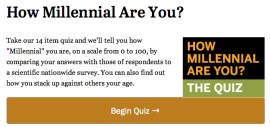
How Millennial
Click to take the Pew Internet quiz.

I just discovered and took the quiz, How Millennial Are You? over at the Pew Internet Research Center website.

The questions cover digital-age habits such as reading newspapers, using mobile phones, and watching television, as well as a fair number of lifestyle issues. It’s interesting to do, and the score places each quiz-taker on a continuum with a range of generations from people in their 70s and above (called the silent generation) to boomers and down through millennials.

Once you answer the questions and get a score, it’s possible to change answers and see how the score changes. A quiz-taker can also look at graphs that depict how various generations of test takers fared in a more scientific survey.

This short exercise can help the parents of 21st Century kids develop a keener sense of how the behavior of various generations changes as digital life intensifies. Teachers may want to give the quiz a try because it can help them gain more insight into the lives of their 21st Century learners.

I scored 70, so I have a lot of digital-age millennial characteristics. On the other hand, despite the fact that my husband is digitally literate, he scored 30 (losing a lot of points for reading at least one newspaper each day and texting rarely). It was especially interesting to look at the graphs and see how we compare to other people in our age ranges.

Take the quiz, have fun, and learn.

Posted in American Academy of Pediatrics, babies and technology, brain, parents and technology

Babies: The Real World or a Tablet Screen?

silo
The silo!

A baby carrier with an iPad holder?

Don’t babies need to be looking around and figuring out things about all the people and things around them? You know, mommy, daddy, toy, cat, dog, book, noise, quiet. I watched my daughter observing and responding to the differences in colors, light, contrasts, and people — real people — practically from the day she was born. Babies may not be able to talk or even move for a long time after birth, but they can watch real life —  and they work hard and learn a lot while they do all of that looking.

Seriously, do parents want a baby to stop figuring out and organizing the real world just to look at a screen — even for a short time?

Downstairs in my basement is an old-fashioned and wonderful Fisher-Price plastic barn and silo filled with people and animals. Two generations of babies and toddlers loved those toys, and now they’re waiting down there in a corner somewhere for the next child. The silo provided hours of interest for our daughter. Once she could sit up she started watching this bright red object. Inside were safe plastic animal toys for when she was learning to grab — but mostly she would knock the silo over or bang on it.

Continue reading “Babies: The Real World or a Tablet Screen?”

Posted in 21st Century parenting, digital change, parents and technology

Three Basic — and Best — Digital Parenting Guidelines

Whenever I have conversations about the challenges of digital parenting, people invariably ask how I might condense all of the 21st Century parenting guidance into just a few helpful suggestions.

digparentingCan you get it down to the three most important tips, I’m asked?

I’ll admit that I’ve tried, on one than one occasion, to identify and condense the many elements that combine to strengthen digital world parenting skills, but the challenge takes an enormous amount of thought and even more time. Moreover, any short and succinct advice has to make it clear that we parents can no longer think about living our lives in two parts — digital and non-digital. If tips are distilled down to the basics, they still need to help adults recognize that our world changes constantly, and also that it requires us to continually learn from our children — refining our parenting strategies as we go along.

The good news is that one of my colleagues, Craig Luntz at the Calvert School in Baltimore, has come up with a three-part framework to help families navigate through changing expectations in the 21st Century world. When he works with parents at his school Craig offers the following three-part digital parenting plan.                      Continue reading “Three Basic — and Best — Digital Parenting Guidelines”

Posted in 21st Century Learning, 21st Century teaching, connected learning, digital life, parents and technology

The 2013 Digital World? What CAN I Be Thankful For?

martipicTGiving
Happy Thanksgiving, everyone!

It’s Thanksgiving 2013, a time when we give thanks for family, friends, and the richness of our lives. It’s also a time to take stock, gain perhaps a bit more insight about the quality of life, and maybe even refrain from always wishing for more.

As a teacher, 21st Century learning advocate, and educational technology enthusiast, I spend much of the year on this blog suggesting ways that families, educators, children, and certainly, my students, can strategize, enrich, and improve their digitally connected lives and, of course, learn enough to avoid potential problems.

But today is different!

We spend so much time grumbling about all the problems that arise in our digital era. So to add some extra fun to our family’s Thanksgiving 2013 celebration, here are a few special experiences and joys that the digital world has brought into my family’s life — for which I am most grateful.

I am thankful that digital life allows me to:                  Continue reading “The 2013 Digital World? What CAN I Be Thankful For?”

Posted in digital learning, Facebook, family conversations, parents and technology, privacy, social media

Privacy Settings Can’t Always Protect You

All of us — children, parents, and teachers — need to think about the security of our privacy settings. Part of learning to live in the digital world involves understanding and competently using these settings, but we also must recognize their limitations.

Privacy WaveOnce we post or share digital content, the privacy of the information depends on the good judgment of others. No matter how securely the  settings, our friends, who in theory understand our expectations, can err in judgment by copying, taking screen shots, or sharing the content in another digital location. When we post data via social media, we cede control of that information to others who may not abide by our privacy preferences.

In a Wired article, Don’t Make My Mistake: Always Think Before You Tweet, Randi Zuckerman, the sister of Facebook founder Mark Zuckerman, describes how she shared a picture with friends, only to have one of those friends share it in a more public way and eventually widely via Twitter. The picture caused a huge media stir, with people laughing that Zuckerman, the sister of the Facebook founder, did not understand the privacy settings. But she understood perfectly — it was her friend who did not get it.

Best Quote

Continue reading “Privacy Settings Can’t Always Protect You”

Posted in 21st Century Learning, data collecting, digital devices, digital learning, research on the web

Digital World Research-What It Tells Us About Causation vs. Association

On a fairly regular basis I hear presenters and parents cite research results about technology and 21st Century kids. Often they justify their points by making comments such as “According to research,” or “Research demonstrates that…”

causationassociationSome time ago, for instance, I heard a presenter comment that too much use of digital devices causes students’ lack of concentration, and she cited a university research study. Trouble is, when I subsequently checked out the research, it was based on 25 participants — a small number on which to form a conclusion and make assumptions about a dramatic outcome. After I read the abstract, I discovered that the researchers who conducted the study concluded that the outcome is an association with kids’ lack of concentration and not a cause. The data did not indicate that too much technology causes a lack of concentration.

The difference between association and causation is significant, and parents, as well as those of us in the educational technology community, need to recognize the difference. Much of our accumulated data about technology outcomes are collected over a short-term, and in many areas we have no data collected long-term. Television statistics are the exception because, after years and years of well-designed, science-based studies, the causal connection between television viewing and childhood behaviors is only now being firmly established. That’s because enough data exist to enable researchers to draw firmer conclusions about how TV screen time affects certain childhood problems.

Continue reading “Digital World Research-What It Tells Us About Causation vs. Association”