I am honored and, yes, thrilled, that my colleagues in the independent school educational technology community selected me to receive the 2015 International Society for Technology Education (ISTE) Independent School Outstanding Educator Award. It recognizes my work connecting colleagues as the founder and moderator of the Independent School Educators’ Listserv (ISED), my experience mentoring classroom teachers at Georgetown Day School and technology colleagues around the country, the work I do supporting the parents of digital kids, and, of course, my blogging.
In the video below, Larry Kahn, the Director of Technology at Iolani School, presents the award.
Collaborating with colleagues from beyond our school walls helps us become stronger, better, and more innovative educators. As Oliver Wendell Holmes wrote, “Many ideas grow better when transplanted into another mind…” To that I would add, “minds from other places.”
I am attending the 2015 International Society for Technology Educators(ISTE) annual conference where it’s a bit of a zoo — a crazy, good, really busy, intellectually stimulating zoo — with people to meet, activities to learn about, lectures to hear, things to play with, information to process, and much more. Collaboration is in the air.
Yes, once again it’s summer! To celebrate the season I’m writing specifically for the parents of digital kids — suggesting ways that parents can use this more relaxed time of year to learn more about their own digital footprints.
While some of the activities are similar to those in apost from last year, this beginning-of-the-summer blog post aims to help parents gain a greater understanding of digital footprints for themselves — and then share this increased knowledge in conversations with their children. The longer-term goal, of course, is to ensure that each child returns to school in the fall with more knowledge about the family’s digital profile, their own digital footprints, and privacy.
Below are some suggestions to help parents get started learning.
Log in and visit your Google dashboard.
Google yourself. See what digital footprints others see when they Google your name oryour email address. Then go to the Dashboard, while you are logged in, and see how Google keeps track of your activities. Dashboard notes everything a person does on Google — from email to images to alerts to searches and much more. Once you finish up learning about your own digital trail, organize a family digital footprint party and help every member of the family go through the same steps.
“We’ll just use something, like, one of those reputation sites and, like, clean things up,” I overheard two teenagers say in a Starbucks line the other day. The two, about high school age, were laughing together at something on their mobile phones.
After serving at a school for 33 years, more than 25 or them as an educational technology faculty member, I am departing in a few weeks and moving on to new experiences. This year I’ve had plenty of time to think about my service on an edtech faculty team, ruminating on my rich experiences. I’ve helped teachers and students use technology in ways that help them grow into more effective and reflective learners, though in truth, I’ve probably learned far more than I’ve helped others learn.
While I will miss the daily joys and the challenges of 21st Century school life, I expect to continue supporting people — students, parents, family, friends, and anyone else — as they discover more about living and learning in a digital world with social media, apps, the latest devices, and whatever else that appears on the edtech horizon. Of course, I’ll keep blogging right here at MediaTechParenting.net.
So below are 25 observations (lessons learned) that grow out of my 25 years of teaching and learning with educational technology.
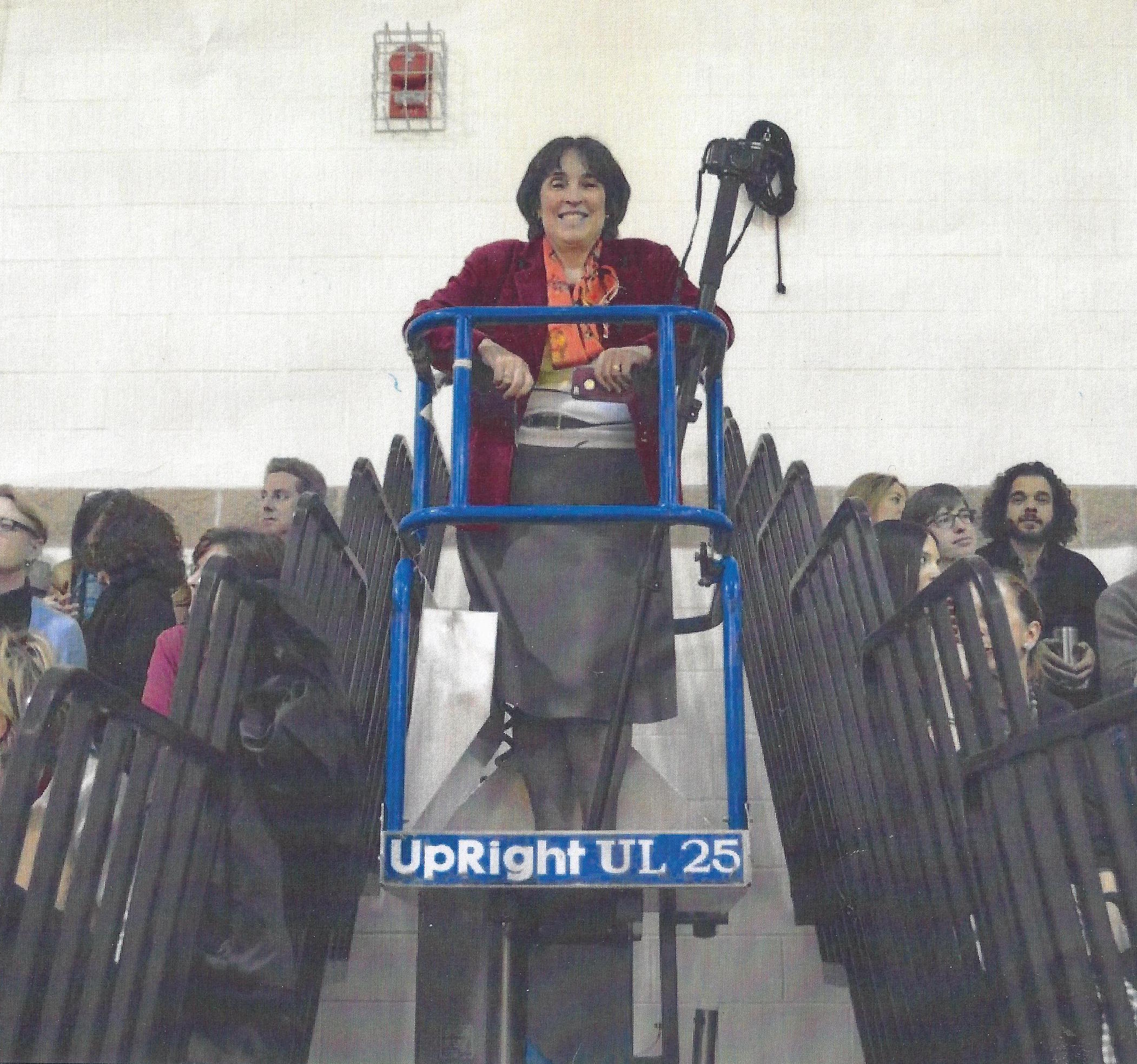
Me in the cherry picker so we can film an assembly from a good angle.
1. The curriculum and student learning are at the core of our work. The mission is to figure out how to help teachers learn new skills so they can help students learn more effectively and productively.
2. Collaborating with teachers on new technology projects in their classrooms is essential and best way to help them learn. Communicating with those teachers is paramount.
3. We need administrators to evaluate faculty members regularly, assessing how teachers infuse technology into the curriculum and how these teachers expand their skills over time.
While we have many good reasons for wearing fitness trackers, Raskin’s piece explains how the device companies accumulate, post, and use our data. More importantly, she describes how the fitness data has inspired public health initiatives — just one more reason to wear a tracker. With all the concern about personal data in our 21st Century lives, it’s nice to know that sometimes the information can be put to good use.
Exactly one year ago, I began wearing my JawboneUP 24 personal fitness bracelet. The first day I put it on, expecting to record 10,000 steps without thinking much about it. Boy, was I wrong. Despite the fact that I exercised four to five times a week, it turned out that many days I was barely getting over 5,000. For weeks I had to focus on accumulating the other 5,000. Over the first month, however, I discovered that I liked keeping track of my steps, and by the day things got easier and easier.
Two years ago, for the first time, students took me aside to wonder aloud how to go about asking their parents not to share photos. It happened again last year when a child commented about baby photos that were especially embarrassing.
What is sharenting?
All of this adult sharing of kids’ images and information is called “sharenting.” A fair number of people, including researchers, are wondering about the effect that too much sharenting has on kids.
A few months ago researchers at the University of Michigan C.S. Mott Children’s Hospitalconducted a survey on the subject. The hospital’s National Poll on Children’s Health investigates topics several times a year, polling adults in around 2000 randomly selected, nationally representative households, about significant health issues that relate to children. In March the hospital announced the results of a November-December 2014 poll that asked 21st Century parents a range of questions about how they use social media to gain knowledge about parenting on social media as well as how they share information about their children.

 I am honored and, yes, thrilled, that my colleagues in the independent school educational technology community selected me to receive the 2015 International Society for Technology Education (ISTE) Independent School Outstanding Educator Award. It recognizes my work connecting colleagues as the founder and moderator of the Independent School Educators’ Listserv (ISED), my experience mentoring classroom teachers at Georgetown Day School and technology colleagues around the country, the work I do supporting the parents of digital kids, and, of course, my blogging.





 Media! Tech! Parenting!
You must be logged in to post a comment.