In his 2008 TED talk, law professor Lawrence Lessig describes the history of copyright policy, illustrating the reasons why our laws in general and copyright laws in particular should evolve to reflect contemporary culture and information.
Thoughtful and thought-provoking, this lecture contains information that can be used as conversation starters for parents and teachers of digital kids.
Read my original post on digital citizenship minutes.
Each time teachers comment on digital citizenship issues in the context of daily lessons and classroom life, they model, as all adults should, a digital intelligence — just what we want our students to embrace, whether they are working or playing in the today’s world.
As educators pay increasing attention to these digital digressions throughout the school day, they demonstrate critical values of 21st Century learning — and life — in a networked world. But more importantly, our students observe that just about every learning activity these days, whether digital or not so digital, incorporates time-tested values such as thoughtful evaluation, respect, collaboration, inclusiveness, and acceptance.
Five Digital Citizenship Minutes to Incorporate into Any Lesson
1. Pause for a moment whenever you use a web site, and explain one or two things that you like about it (or don’t like). Or explain just how you found the website
2. Share an irritating or inconsiderate e-mail or cell phone moment — telling your students how it feels and why.
A year ago I asked my fifth-graders to write podcast scripts. They wrote about teasing, cyberbullying, gossip, intention vs. consequence, advertising, digital footprints, and the lack of facial cues in electronic communication. Working mostly in collaborative groups, my students recorded complete “’casts” in our informal laptop studio.
As always when it comes to 21st Century learning, a few students improved upon my lesson plan and asked to write podcasts for their other teachers. The resulting efforts helped students refine their digital citizenship perspectives. One student noted, “When an electronic problem [like cyberbullying] becomes a ‘big problem,’ teachers talk about it at school. How come we don’t talk about these things when they aren’t [big] problems?”
Identifying relevant TED Talks on various subjects just got easier.
Parents, teachers, lifelong learners: these talks contain wide-ranging information, ideas, and lots of content that 21st-century learners be used in reports, presentations, and other learning activities.
According to the e-mail with the graphic below, TED Talks will now be posted on iTunesorganized by curated collections students, educators, families, and, of course, lifelong learners. Click on the image to visit iTunes, choose a collection, and download the lectures that interest you. The link may be slow, but you can always go directly to iTunes.
The tenor of the political advertising in this election season is appalling, and it will get worse. Because no code of best practices exists when it comes to campaign advertising, the current presidential election cycle media will feature unending ads that stretch the truth or make up the facts outright and deliver them straight into the lives of kids. While it’s a fine opportunity to help citizens, young and old, strengthen their media literacy skills, television is over-exposing all of us to some unfortunate and distressing content.
Click to visit.
To Learn a lot more, listen to a recently broadcast Diane Rehm Show about the non-candidate SuperPACs that are spending enormous sums on political advertisements. Jane Mayer’s recent New Yorker article, Attack Dog, is another comprehensive article. Talking to children about what they are seeing on television is critical, especially during an election cycle.
In a February 26, 2012 piece published at the USA Today Teachers’ Lounge (link no longer available), media lit guru, Frank Baker pithily describes the situation. He writes:
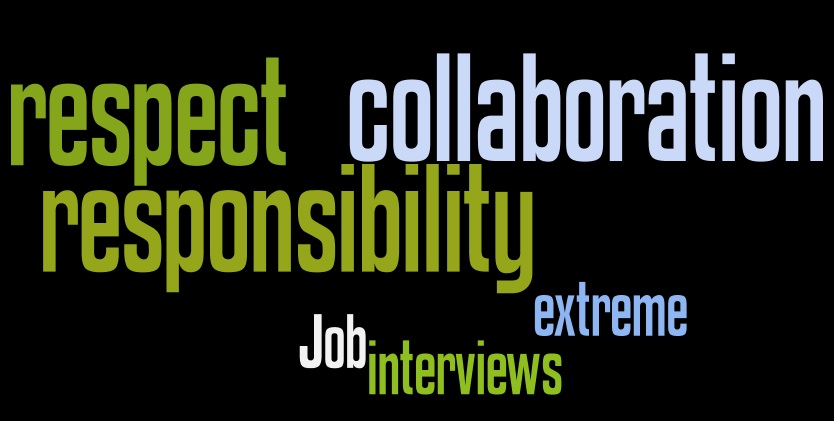
At a time when cyber-bullying is a nationwide problem and negative political campaign advertisements are saturating the airwaves, some compelling signs indicate that students who are not immersed in activities that emphasize respect, responsibility, and collaboration may be disadvantaged in job interviews.
According to Job Interviewing, to the Extreme, an article at LATimes.com, many employers are incorporating new and sometimes innovative techniques into job interviews. These include interviewing two candidates at once to see how they communicate with one another, asking interviewees to solve offbeat problems, and conducting some part of an interview on Twitter. The goal of these unconventional methods is to figure out how an employee might function under pressure and whether he or she might communicate awkwardly or not know how to be a team player.
Best Quote from the Article
…while some applicants reveal a creativity that might have been smothered in a more conventional interview process, others expose tics and weaknesses that might have remained hidden.
Politico, a Washington weekly newspaper that meticulously covers all things political, published this nifty Twitter graphic illustrating the tweeting environment during 2012 State of the Union (SOTU) speech. The data collection begins around 9:05 and continues until 10:40 eastern time. President Obama entered the chamber around 9:05 and the Republican response ended around 10:40.
The infographic includes a huge amount of data, illustrating the times (and issues), when the frequency of #SOTU tweets went up, and other hashtag (#) topics that people included in their tweets.
Twitter’s infographic illustrates an enormous amount of social networking activity. Use it as a classroom or dinner table conversation topic. providing a glimpse into real-time civics and history.



 Media! Tech! Parenting!
You must be logged in to post a comment.