Posted in 21st Century parenting, 21st Century teaching, digital citizenship, digital kids, ethical behavior, teaching digital kids, values in digital life

Beauty Contests? What Will It Take for Us to Really Lead Our Digital Kids?

socialmediakidsIt is a truth universally acknowledged that whenever a new technology feature comes into vogue, children and adolescents come into possession of digital skills in want of copious adult tutelage.

Or at least this should be universally acknowledged.

Just now, in my part of the world, we are in the midst of an Instagram beauty contest phase. Interestingly, however, parents and educators who have spent the past 10 years connected in any way to the teen-tween digital world will recognize that, at a minimum, this is actually beauty contest 3.0.

I recall two other student beauty contest episodes, each occurring on a different digital playground. Initially, they appeared on make-your-own websites, then on MySpace. Now we have Instagram.

As I said the other morning to a concerned mom, behaviors get recycled each time a neat new whiz-bang digital opportunity emerges. Typical kid behavior gets paired with a powerful app, but mostly without the benefit of that adult tutelage referred to above. Also, kids love contests so it’s natural that the idea comes up.

Children are growing up in two worlds. Families and schools now have two childhood environments to supervise —  face-to-face and the digital — and kids are learning and playing in two places, irrevocably intertwined. School and home guidance acclimate children mostly to the face-to-face world, assuming that the lessons automatically carry over to digital endeavors. They don’t.

Continue reading “Beauty Contests? What Will It Take for Us to Really Lead Our Digital Kids?”

Posted in 21st Century Learning, assessing learning, digital learning resources, e-portfolios, electronic portfolios, NAIS Conference Reports, parents and technology, teaching digital kids

Getting Started With Electronic Portfolios: My NAIS Conference #2

You do not always expect the first workshop, on the first day of a conference to be a slam-dunk, but my 8:00 A.M. Thursday morning session was awesome.

Check out the online presenters' resources.
Check out the online presenters’ resources.

Every bit of information that I collected at the Garrison Forest School workshop on electronic portfolios, presented at the National Association of Independent Schools (NAIS) annual conference in Philadelphia, will help me start an e-portfolio project at my school. As the four presenters shared their many resources and described their electronic portfolio research, my mind zoomed ahead to my return to school — all this before the end of the first hour of the conference.

I’ve been thinking about helping teachers and students create e-portfolios for some time, but with so many factors to consider and so much to figure out, I’m always a bit stumped when I think about the extensive collaboration that needs to take place. The benefits for teachers, students, and parents are clear, but the process takes an enormous amount of time to plan and carry out, and time is always at a premium. Yet we all know that twenty-first Century learners need to be able to think about, examine, evaluate, and extend their work if they are to be, well — better 21st Century learners. E-portfolios support this learning process.

Interestingly, about two weeks before this conference, two teaching teams that I support indicated – out of the blue — their interest in developing some sort of electronic portfolio project, so I am fortunate to have a small group of educators who want to get started. This workshop has essentially handed me the knowledge as well as a map to lead me.

Continue reading “Getting Started With Electronic Portfolios: My NAIS Conference #2”

Posted in 21st Century Learning, communicating with grandparents, digital parenting, family conversations, grandparents, intention versus consequence, parents and technology, teaching digital kids

Whose Eyes Are Checking Out That Digital Content?

In his recent post over at the Changing Aging blog, Kavan Peterson describes a short video, Forwarders. Intended as a parody of people who continuously forward e-mail, the video reinforces stereotypes about elders and aging. It’s sad that this short film focuses solely on one older adult, especially since so many people of all ages are extreme (and irritating) forwarders.

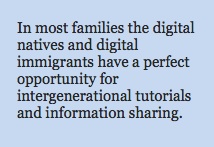
generational tutorialsWhile it’s intended to be funny, the video’s other message is that old people with wrinkles are silly and inept — at least that’s my interpretation. I’ll bet that the video producer — I am guessing an adolescent or young adult — probably cherishes a fair number of lifelong relationships with grandparents. This parody promotes a stereotype that could have been alleviated simply by adding in a few younger characters who also need reforming. (I posit a guess about the creator/producer’s age after looking over other published web content.)

The video and others like it also raise a question. How do we help 21st Century learners who are natural Internet content “whizzes” to understand that everything uploaded is subject to interpretation?

As a teacher who concentrates on educational technology, I frequently hear the refrain, “But I did not mean to hurt that person,” usually after a student has created and uploaded what he or she considered to be amusing content. Sometimes it is, sometimes it isn’t, and sometimes various readers or viewers interpret the message differently. What my students slowly learn is that digital content may be funny to one person, not funny to another, and for some individuals downright insulting.

In today’s connected society digital natives — born into a world of computers, cell phones, and various other gadgets — find it easy to create content, but sometimes they forget that what they do and say (and upload) circulates far and wide. Different people will watch and may reach different conclusions about the work. One person’s joke can unintentionally malign others. Humor that is appropriate for a person at one age is not so funny when it’s uploaded into the world at large for everyone to see. Digital natives need to learn and respect the ways that different people view the world through slightly different lenses. Most professional writers of parody think long and hard about every detail of a project, interchanging those lenses as they create.

Continue reading “Whose Eyes Are Checking Out That Digital Content?”

Posted in 21st Century Learning, digital citizenship, digital learning, family conversations, parents and technology, privacy, teaching digital kids

Digital Footprints Video – Check it Out!

A well done and interesting presentation about digital footprints found at Harvard’s Berkman Center for Internet and Society website.

Good for middle school as well as older students. Parts of this video can be shared with fifth graders, but the whole video may a bit too scary for that age.

Parents, on the other hand, may consider this as an excellent resource for family conversations about digital life.

You might also enjoying reading my post, Digital Footprints, Changing What We Teach.

Posted in digital change, digital parenting, educating digital natives, kids changing lives, parents and technology, teachers, teaching digital kids

Do Today’s Digital Kids Learn Differently?

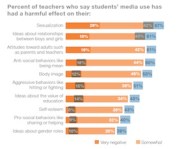
Image from Children, Teans, and Entertainment Media: The View from the Classroom
Image from Children, Teens, and Entertainment Media: The View from the Classroom

In case you missed it, check out the November 1, 2012 New York Times article, Technology Changing How Students Learn, Teachers Say.

Technology reporter Matt Richtel shares information about two recent studies that examine, on the basis of educator surveys, how today’s digital children may be learning differently than in the past. Although individual responses are subjective, the results of the surveys “are considered significant because of the vantage points of teachers who spend hours a day observing students.”

One survey, conducted by the Pew Internet and American Life Project, examined responses from 2,462 teachers. The other, conducted by Common Sense Media, surveyed 685 educators.

It all comes down to attention span. In both surveys, teachers expressed concern that students, used to fast-paced, always changing activities, are less able to focus on an academic task for a prolonged period.

Continue reading “Do Today’s Digital Kids Learn Differently?”

Posted in 21st Century Learning, American Academy of Pediatrics, digital learning, digital parenting, parents and technology, teaching digital kids, wireless gadgets

8 Tips to Help Parents Raise Stronger 21st Century Learners

As we approach the end of 2012 and the holiday season that will surely introduce new gadgets and devices into many of our households, it’s a good time to reassess family digital expectations.

Learning in the 21st Century requires that children competently use digital resources much of the time. To do this each student needs plenty of experience making choices, understanding limits, and mastering the art of filtering out what is immaterial at any given point. Children who get this guidance at home and at school are the most prepared to become effective learners.

These eight tips aim to help parents of digital kids to get started. If you teach, consider sharing them with your students’ parents.

1. Place computers and tablet devices in central, well-traveled locations — away from bedrooms and private spaces.

2. Make adults, not children, the administrators on all computers, including laptops until you are certain of each child’s decision-making. Know what is installed on your child’s mobile devices.

3. Print and post rules and expectations. Specify the times when you do not want your children using computers. Emphasize that your family rules are in effect when your child goes to a friend’s house.

4. Help your children to come up with a strategy that helps them to distance themselves whenever and wherever inappropriate digital activities occur.

5. If your children have mobile phones, have you discussed appropriate use, texting, and limits on a phone’s digital camera? Download a PDF of my cell phone contract.  Check out my contracts and agreement page.                     Continue reading “8 Tips to Help Parents Raise Stronger 21st Century Learners”

Posted in digital citizenship, digital parenting, digital world conversations, electronic communication, family conversations, parent education, parents and technology, teaching digital kids

E-mail, Scandals, and Digital Footprints — AGAIN!

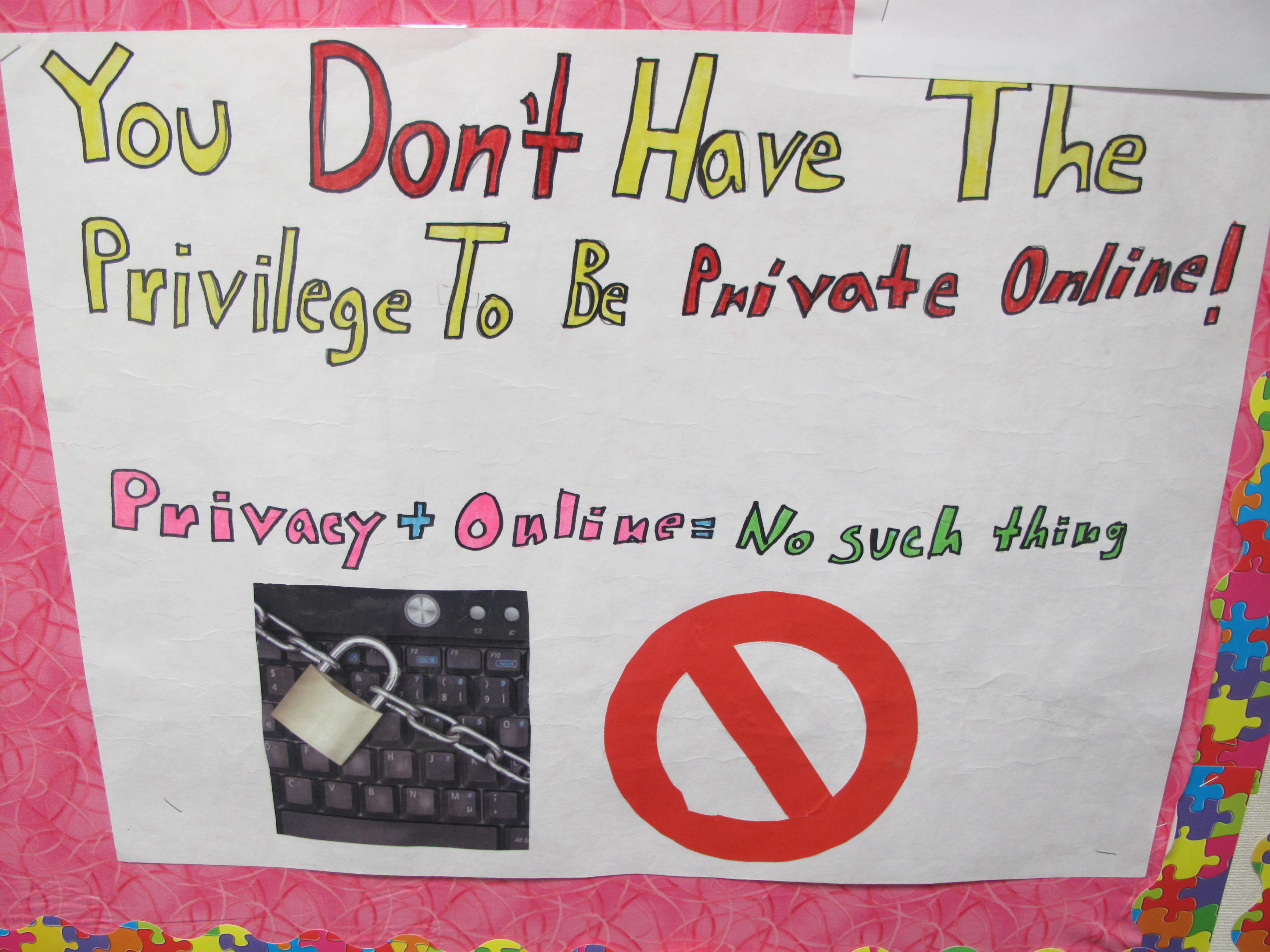
One of the digital citizenship posters made by my students a year or two ago.

On a fairly regular basis, a public scandal occurs, and these days just about every one of them reminds us of how ignorant people are about the transparency of their digital footprints.

If reading about the most recent scandal doesn’t convince you of how easily accessible digital footprints can be, then this November 17, 2012 Washington Post article should. In The FBI’s Long Reach Into Digital Lives, reporters Greg Miller and Ellen Nakashima describe how easily the FBI gets into an individual’s e-mails and how accessing one account leads to exploring the accounts of other people who have sent or received e-mails.

Interesting Quote from the Post Article

Investigators with a warrant to search a house for drugs can seize evidence of another crime… But the warrant does not allow them to barge into the house next door… But what are the comparable boundaries online? Does a warrant to search an e-mail account expose the communications of anyone who exchanged messages with the target?

Scandals arising from common digital mistakes can provide opportunities for adults and children to participate in family conversations, learning more about their online and networked world. However, if you do not want to talk about the scandal, that’s fine — talk about the lack of privacy that everyone experiences today. Children who make mistakes have no protection as they explore the digital world, because what they do can easily become public and embarrassing. In any past era their common and developmentally appropriate errors would mostly remain private, but with today’s speedy and electronic communication tools, that’s less and less likely.

We are not trying to scare children, but we are trying hard to make common sense second nature.
Continue reading “E-mail, Scandals, and Digital Footprints — AGAIN!”