Posted in advertising, American Academy of Pediatrics, digital kids, digital world conversations, media diet, media literacy, screen time

Advertising With Kids as Targets

For several months I’ve been carrying around a New York Times article, How Advertising Targets Our Children, from the February 11, 2013 edition. Written by pediatrician Perri Klass the Well Blog post points out that recently published research links, even more strongly, the exposure of alcohol advertising to a child’s movement toward unhealthy behaviors.

Health Children Media Ed
Check out the Media Resources at HealthyChildren.org.

Dr. Klass writes about Exposure to Alcohol Advertisements and Teenage Alcohol-Related Problems (abstract), a Pediatrics article describing new research that finds a stronger association between unhealthy behaviors and the amount of advertising in the lives of children and adolescents. The researchers followed nearly 4,000 children in grades seven through ten.

Read the full text of the Pediatrics article.

In her article Klass quotes the researchers, experts from the Yale Rudd Center for Food Policy, and pediatrics professors from the Children’s Hospital at Stanford University who have studied the links between childhood obesity and screen time.

Continue reading “Advertising With Kids as Targets”

Posted in conversations on commenting, digital footprints, digital learning, digital parenting, digital world conversations, family conversations, parents and technology

Encouraging Digital Kids to Write Polished Comments

Comment

Part of becoming a strong 21st Century digital learner is mastering the art of writing and sharing comments online.

If you read comments at the end of articles or blog postings, you have surely discovered more than a few inappropriate and sometimes distasteful remarks. Sometimes people leave these comments anonymously. Posted by folks who do not understand why websites invite visitors to share thoughts and ideas, many unfiltered remarks are permanently attached to websites — personal indiscretions waiting for the whole world to discover. Even leaving an anonymous comment is not particularly secure.

Read a short post and watch a video on newspaper comments, uploaded by the Nieman Journalism Lab at Harvard. Some newspapers sites, such as the Boston Globe, post a short and succinct comment policy with a link to a more detailed document.

Helping children avoid public website blunders is one reason to discuss commenting etiquette. Children don’t know or they forget that all comments leave digital footprint trails, little paths of information that last much longer than a child’s pre-adolescent and even teenage years.

Continue reading “Encouraging Digital Kids to Write Polished Comments”

Posted in digital learning, digital parenting, digital world conversations, interesting research, parents and technology, research on the web, social media, social networking

Parents Use More Social Media – Often to Ensure Children’s Security

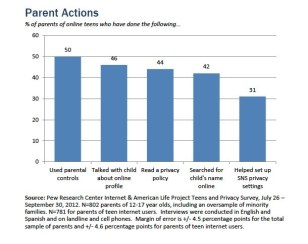
pew parents teen social media responses
Graph from Pew Internet Teens and Privacy report

In November the Pew Center on Internet and American Life together with Harvard’s Berkman Center for Internet and Society published a new survey, Parents, Teens, and Online Privacy. This 2012 Teens and Privacy Management Survey gathered data from 802 teens and their parents. Everyone who participated in the survey lived in the United States; however, participants could take the survey in either English or Spanish.

Interesting Results

  • Parents report they are using a lot more social media — 66% of parents with children who use social media now use it themselves (compared with 58% in the 2011 survey).
  • One reason that parents are increasing their use of social media sites is to be able to facilitate ongoing family conversations about content.
  • Parents appear to worry more about advertisers who gather information about a child’s online activities than about a child’s possible contact with unfamiliar people.
  • Some teens whose parents are friends have learned how to restrict the information that parents see, but in general, they are positive about friending a parent.
  • Parents are increasingly aware of privacy policies — 44% have read a policy for a social media that one of their children uses and 39% told the survey that they are helping their children set up social media privacy settings.
  • Parents are concerned about a child’s online reputation, but the concerns are the highest as children get closer to applying to college.
  • Reputation management, when juxtaposed with the adolescent years, is tricky for teens.
Posted in digital citizenship, digital parenting, digital world conversations, electronic communication, family conversations, parent education, parents and technology, teaching digital kids

E-mail, Scandals, and Digital Footprints — AGAIN!

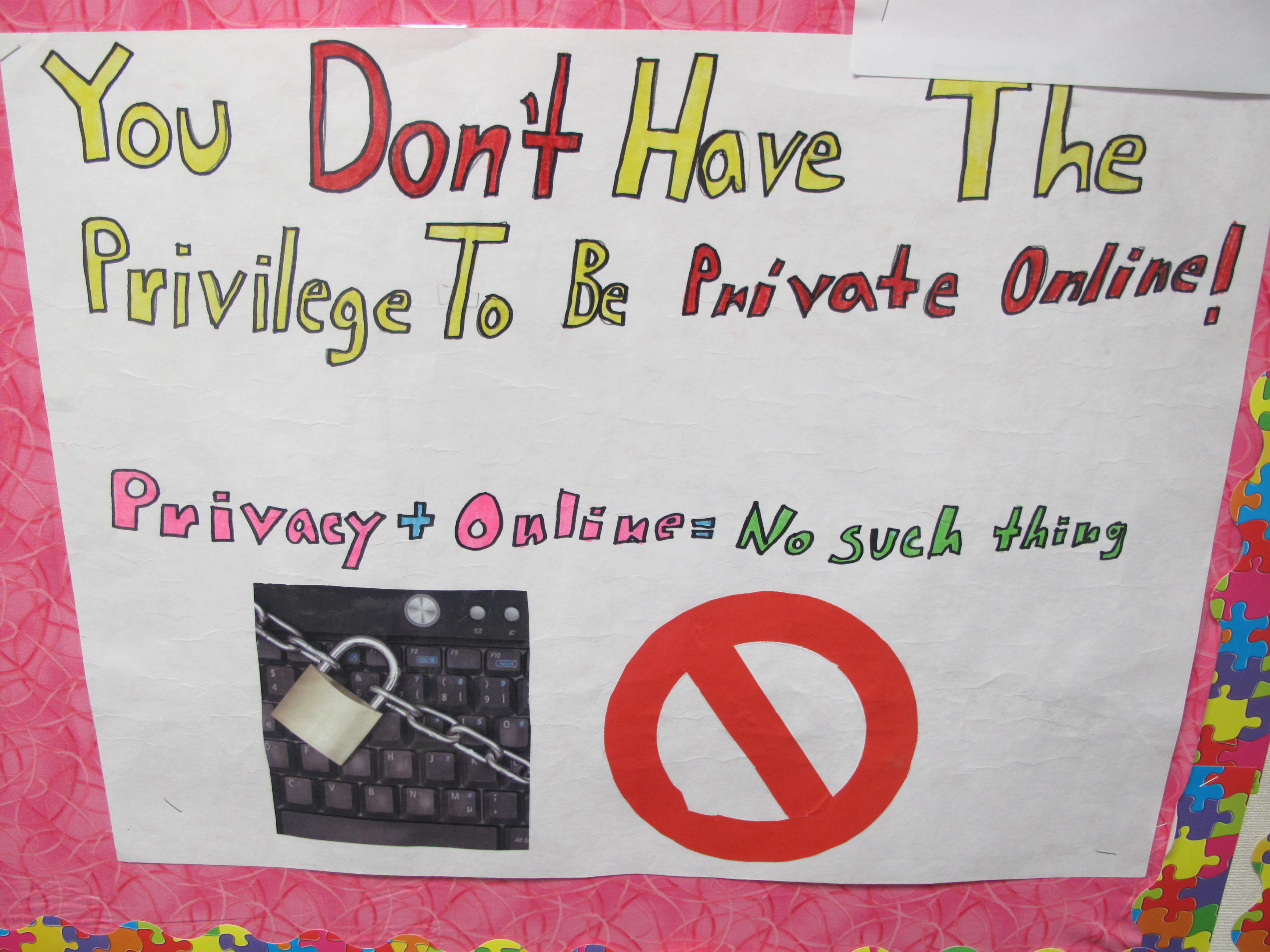
One of the digital citizenship posters made by my students a year or two ago.

On a fairly regular basis, a public scandal occurs, and these days just about every one of them reminds us of how ignorant people are about the transparency of their digital footprints.

If reading about the most recent scandal doesn’t convince you of how easily accessible digital footprints can be, then this November 17, 2012 Washington Post article should. In The FBI’s Long Reach Into Digital Lives, reporters Greg Miller and Ellen Nakashima describe how easily the FBI gets into an individual’s e-mails and how accessing one account leads to exploring the accounts of other people who have sent or received e-mails.

Interesting Quote from the Post Article

Investigators with a warrant to search a house for drugs can seize evidence of another crime… But the warrant does not allow them to barge into the house next door… But what are the comparable boundaries online? Does a warrant to search an e-mail account expose the communications of anyone who exchanged messages with the target?

Scandals arising from common digital mistakes can provide opportunities for adults and children to participate in family conversations, learning more about their online and networked world. However, if you do not want to talk about the scandal, that’s fine — talk about the lack of privacy that everyone experiences today. Children who make mistakes have no protection as they explore the digital world, because what they do can easily become public and embarrassing. In any past era their common and developmentally appropriate errors would mostly remain private, but with today’s speedy and electronic communication tools, that’s less and less likely.

We are not trying to scare children, but we are trying hard to make common sense second nature.
Continue reading “E-mail, Scandals, and Digital Footprints — AGAIN!”

Posted in digital parenting, digital world conversations, parent child conversations, parent education, parents and technology

Digital Kids to Parents: Listen Up!

With more than 30 years as a teacher including over 20 in the educational technology field, I’ve heard many kids reflect thoughtfully, and not so thoughtfully, on their parents’ digital skills.

Here are the seven most common “I Wish” statements that I’ve heard expressed by children over the last 16 or 17 years. Two of them, I can report, my daughter also mentioned to me ages ago.

Kids wish their parents and other adults would:         Continue reading “Digital Kids to Parents: Listen Up!”

Posted in 21st Century Learning, digital citizenship, digital world conversations, parents and technology

Lawrence Lessig-MIT Media Lab Talk on Reforming US Congress

I’ve embedded an interesting presentation by Lessig about reforming the United States Congress! Highlights are from a much longer presentation at the MIT MediaLab Conversation series.

Very much 21st Century Learning! And a great opportunity for a civics lesson.

Howard Rheingold presents on May 10th and you can even Tweet in with your questions.

Posted in 21st Century Learning, digital citizenship minute, digital learning, digital world conversations, parents and technology, teaching digital kids

The Digital Citizenship Minute: Digital Digressions in the Classroom

Read the piece at NetFamilyNews.org.

A year ago I asked my fifth-graders to write podcast scripts. They wrote about teasing, cyberbullying, gossip, intention vs. consequence, advertising, digital footprints, and the lack of facial cues in electronic communication. Working mostly in collaborative groups, my students recorded complete “’casts” in our informal laptop studio.

As always when it comes to 21st Century learning, a few students improved upon my lesson plan and asked to write podcasts for their other teachers. The resulting efforts helped students refine their digital citizenship perspectives. One student noted, “When an electronic problem [like cyberbullying] becomes a ‘big problem,’ teachers talk about it at school. How come we don’t talk about these things when they aren’t [big] problems?”

Continue reading “The Digital Citizenship Minute: Digital Digressions in the Classroom”