Posted in 21st Century Learning, apps, assessing learning, digital learning, parents and technology

Wordfoto – Great Fun With Pictures and Word Lists

One of my sunflower pictures with words added for a presentation on professional development.

I have a new favorite app — Wordfoto. Interestingly it’s designed for an iPhone but does not yet have an iPad version.

With the Wordfoto application, I make a word list and then have some fun designing art. I select a picture as a background to highlight my words. I can use an image that comes with the app, I can use one of the pictures in my iPhone photo galleries, or I can take a new picture.

When I combine the picture and the word list — voila, a cool Wordfoto. The app comes with a variety of editing options, allowing users to play with the image, crop it, create styles, and fine tune the texture of the pictures. Wordfoto also comes with preset styles that introduce texture, color, and depth variations, making it easy for new users to get started.

Newly created images can be easily e-mailed, posted to Facebook, and more. Once e-mailed, the Wordfoto jpg images can be incorporated into other projects.

Potential uses? Spelling lists, messages and cards, vocabulary practice, event signs, and much more. The images will also be useful as illustrations for school reports, and I’m excited because I design occasional images for my blog posts.

Posted in 21st Century Learning, digital learning, Evaluating Web Resources, networking, parents and technology

My Extreme Professional Development

Over the past 10 days I have attended multiple, jam-packed professional development events. I’m beginning to think of it in reality show lingo as my extreme professional development experience, because I’ve encountered so many colleagues along with ideas, hands-on strategies, learning theories, and thoughtful approaches, all focused on becoming better teachers, collaborators, and learners in the 21st Century. One over-arching idea applies to all of my activities: learning, unlearning, and relearning are now routine. Anyone not comfortable with these three concepts — connected and in tandem — needs to get acquainted with them ASAP.

I’m reminded of a quote from futurist Alvin Toffler, “The illiterate of the future are not those that cannot read or write. They are those that can not learn, unlearn, and relearn.

My extreme adventure started about 10 days ago when I presented in the Virginia Shenandoah Valley at the Virginia Association of Press Women. I described how technology has transformed the way we all learn and how specific content is now less important than our skill at discovering information, evaluating it, and using it well. The digital content is out there for everyone to find, I told the group. The role of adults and teachers is to ensure that as we teach one area of content we also ensure that children are developing the skills to recognize, evaluate, and use quality information.

I drove home on Saturday and left again on Sunday for the annual AIMS Technology Retreat on the Maryland Eastern Shore.

Continue reading “My Extreme Professional Development”

Posted in 21st Century Learning, digital citizenship minute, digital learning, digital world conversations, parents and technology, teaching digital kids

The Digital Citizenship Minute: Digital Digressions in the Classroom

Read the piece at NetFamilyNews.org.

A year ago I asked my fifth-graders to write podcast scripts. They wrote about teasing, cyberbullying, gossip, intention vs. consequence, advertising, digital footprints, and the lack of facial cues in electronic communication. Working mostly in collaborative groups, my students recorded complete “’casts” in our informal laptop studio.

As always when it comes to 21st Century learning, a few students improved upon my lesson plan and asked to write podcasts for their other teachers. The resulting efforts helped students refine their digital citizenship perspectives. One student noted, “When an electronic problem [like cyberbullying] becomes a ‘big problem,’ teachers talk about it at school. How come we don’t talk about these things when they aren’t [big] problems?”

Continue reading “The Digital Citizenship Minute: Digital Digressions in the Classroom”

Posted in 21st Century Learning, collaboration, digital learning, parents and technology, social entrepreneurs

SOccket! Collaboration, Creativity, and Tech Create an Energy-Producing Soccer Ball

Jessica Matthews, a co-creator of the energy-producing soccer ball, SOccket, visited my school today, taking the place by storm with her stories and engaging presentation.

A collaborative, 21st Century learning team working together for an undergraduate college class project, envisioned a soccer ball that might create clean energy as it moved around, while still being a ball for playing soccer. Their SOccket invention is astonishing and inspiring, creating enough energy to plug in a lamp or charge a mobile phone. Now, several years later, two members of the team have become social entrepreneurs, and SOccket is in production.

This CBS This Morning report gives lots more background. Two of the students, Jessica and her former classmate Julia Silverman, formed a start-up company, UnCharted Play and you can watch company’s introductory video, with an intro by Bill Clinton.

Continue reading “SOccket! Collaboration, Creativity, and Tech Create an Energy-Producing Soccer Ball”

Posted in 21st Century Learning, blogging, digital learning, digital parenting, parents and technology

Thinking About a Blog?

Visit Start a Family Blog

Are you thinking about starting a blog for school, work, or family? It a terrific communication opportunity.

At SomeNovelIdeas, a blog authored by librarian Stacy Nockowitz, would be bloggers will find a comprehensive list of links to help them get started. She organizes her links into following categories:

    • Blogging Basics
    • Blogging Resources
    • Blogs About Blogging
    • Blogs to Follow
    • Blogging Platforms
    • Images

Also included at the bottom of the resource page is a glossary of blogging terms.

Last year I taught a short blogging course to parents at my school. My Start a Family Blog classhosted on a WordPress blog for two months, is still available.

Posted in 21st Century Learning, Bookmark It!, cyber-bullying, digital citizenship, digital learning, hate groups on the web, information freedom, parent child conversations, parents and technology

The Teaching Tolerance Website: Use It-BookMark It!

Visit Teaching Tolerance!

It’s a privilege for me to write occasional posts for the Teaching Tolerance blog. However, years before I ever wrote a word for the Tolerance website, I used it as a reference and information source to develop my teaching skills and expand my understanding of the world.

You should too.

If you don’t know about Teaching Tolerance, an arm of the Southern Poverty Law Center, or if you don’t visit the website on a regular basis, you are missing an ever-expanding information universe focused on human rights, diversity, anti-racism, community-building, acceptance, tolerance, inclusion, and much more. In the digital age, with information and misinformation moving at lightning speed, we cannot learn too much about these topics.

Continue reading “The Teaching Tolerance Website: Use It-BookMark It!”

Posted in cell phones, digital learning, digital parenting, electronic communication, online communication, parent child conversations, parents and technology

Sherry Turkle TED Lecture-Connected but Alone?

The TED Talk site just posted the most recent lecture by MIT professor and psychologist Sherry Turkle. It’s embedded below.

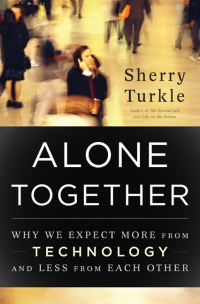
In her presentation, Professor Turkle illustrates several of the most compelling issues from her recent book, Alone Together. She points out that technology may give us an illusion of togetherness with others, but she challenges us to understand that digital connectedness is not a substitute for person-to-person interaction.

  • Are we hiding from each other even as we are connected?
  • With fewer face-to-face conversations with one another are we less able to learn how to have conversations with ourselves?
  • Do feelings that no one is really listening to us make us want to spend more time with machines that make us feel like these devices are listening to us?
  • Are people increasingly willing to settle for the pretend empathy of devices and robots?

Continue reading “Sherry Turkle TED Lecture-Connected but Alone?”