Posted in 21st Century Learning, blogging, digital learning, educating digital natives, parents and technology, web 2.0, writing

If You Really Want Your Digital Kid to Write Well – Start a Family Blog

After reading a January 5, 2013 post on Edudemic, How and Why Teachers Should Blog, I want to share a blogging experience at my school.

I have the honor of working with a small group of amazing third-grade teachers — my colleagues — and last summer they decided to begin blogging with their students. This past fall each of the teachers set up a classroom blog at KidBlog. This student-oriented blogging site is designed to offer maximum privacy to young writers, but it also offers the opportunity for more access — and more readers — if desired. Interestingly, while the three classroom blogs are all similar, each has slight variations that reflect the personalities of the kids and the ideas of the teacher.

Visit KidBlog!
Visit KidBlog!

After orienting their students to the idea of blogging — discussing appropriate tone, privacy, and respect — the teachers let the children write. Third graders have learned to read one another’s work and make comments and suggestions. Sometimes they share complete stories, and at other times they write more spontaneously.

Continue reading “If You Really Want Your Digital Kid to Write Well – Start a Family Blog”

Posted in 21st Century Learning, digital learning, digital parenting, evaluating web site resources, online research, parents and technology, research on the web

10 Ways to Help Students Evaluate Digital Information

goodwebsitebadwebsiteAlthough I am a big fan of encouraging students to begin any research project with curated resources such as the online databases at a school or public library, I know that many learners head straight for Google.

When students make garden-variety searches on Google, teach them to investigate and ask questions about what they find, especially if they are planning to use a website to learn more about a topic. The strongest 21st Century learners will make the process of asking evaluative questions second nature — examining each and every site before deciding whether or not to use the information.

Questions to Ask About Any Digital Resource          Continue reading “10 Ways to Help Students Evaluate Digital Information”

Posted in digital learning, digital parenting, digital world conversations, interesting research, parents and technology, research on the web, social media, social networking

Parents Use More Social Media – Often to Ensure Children’s Security

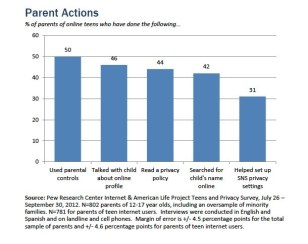
pew parents teen social media responses
Graph from Pew Internet Teens and Privacy report

In November the Pew Center on Internet and American Life together with Harvard’s Berkman Center for Internet and Society published a new survey, Parents, Teens, and Online Privacy. This 2012 Teens and Privacy Management Survey gathered data from 802 teens and their parents. Everyone who participated in the survey lived in the United States; however, participants could take the survey in either English or Spanish.

Interesting Results

  • Parents report they are using a lot more social media — 66% of parents with children who use social media now use it themselves (compared with 58% in the 2011 survey).
  • One reason that parents are increasing their use of social media sites is to be able to facilitate ongoing family conversations about content.
  • Parents appear to worry more about advertisers who gather information about a child’s online activities than about a child’s possible contact with unfamiliar people.
  • Some teens whose parents are friends have learned how to restrict the information that parents see, but in general, they are positive about friending a parent.
  • Parents are increasingly aware of privacy policies — 44% have read a policy for a social media that one of their children uses and 39% told the survey that they are helping their children set up social media privacy settings.
  • Parents are concerned about a child’s online reputation, but the concerns are the highest as children get closer to applying to college.
  • Reputation management, when juxtaposed with the adolescent years, is tricky for teens.
Posted in 21st Century Learning, choosing reliable resources, digital learning, evaluating web site resources, parents and technology, research on the web, Wikipedia

A Book About Wikipedia to Read With Children

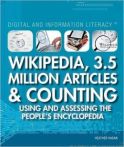
Image from the Barnes and Noble website.

Wikipedia is cool, Wikipedia is filled with information, and Wikipedia is great fun to visit.

That said, reminding children about the authority of references and the expertise of authors — whenever children begin research — is an important part of teaching and parenting. A critical 21st Century and life skill is understanding how to go about judging the quality of references and especially learning how to figure out when information is not up to snuff.

If students start out a project by looking up a topic on Wikipedia, and many of them do, they should hear — over and over at every age — about the importance of seeking out and reading other resources to confirm the facts. Adults, too, need to make this a habit.

truth in numbers
Image from Amazon site.

A new book, Wikipedia: 3.5 Million Articles and Counting, offers parents and educators a great opportunity to read together and learn more — lots more — about Wikipedia. Author Heather Hasan writes in detail about the history and philosophy of this mammoth open-source encyclopedia, explaining how Wikipedia works and describing how the editors keep track of new entries, edits, and re-edits.

Hasan points out the ways that Wikipedia writers occasionally argue over topics, and she notes that editors often decide to lock down a subject or entry. Other short sections of the book share Wikipedia facts and myths, a glossary, and several pages of bibliographic references.

If you read this book with children in your family or students in your class, be sure to have continuing conversations, both while reading the book and afterwards, about the importance of expertise and authority, pointing out that another reason to confirm the facts — aside from worrying about misinformation — is to learn whether even the experts disagree.

An excellent Wikipedia documentary, Truth in Numbers, is available at Amazon and includes interviews with many of the people who have helped the Internet to develop and grow — the movers and shakers of the World Wide Web.

Posted in 21st Century Learning, American Academy of Pediatrics, digital learning, digital parenting, parents and technology, teaching digital kids, wireless gadgets

8 Tips to Help Parents Raise Stronger 21st Century Learners

As we approach the end of 2012 and the holiday season that will surely introduce new gadgets and devices into many of our households, it’s a good time to reassess family digital expectations.

Learning in the 21st Century requires that children competently use digital resources much of the time. To do this each student needs plenty of experience making choices, understanding limits, and mastering the art of filtering out what is immaterial at any given point. Children who get this guidance at home and at school are the most prepared to become effective learners.

These eight tips aim to help parents of digital kids to get started. If you teach, consider sharing them with your students’ parents.

1. Place computers and tablet devices in central, well-traveled locations — away from bedrooms and private spaces.

2. Make adults, not children, the administrators on all computers, including laptops until you are certain of each child’s decision-making. Know what is installed on your child’s mobile devices.

3. Print and post rules and expectations. Specify the times when you do not want your children using computers. Emphasize that your family rules are in effect when your child goes to a friend’s house.

4. Help your children to come up with a strategy that helps them to distance themselves whenever and wherever inappropriate digital activities occur.

5. If your children have mobile phones, have you discussed appropriate use, texting, and limits on a phone’s digital camera? Download a PDF of my cell phone contract.  Check out my contracts and agreement page.                     Continue reading “8 Tips to Help Parents Raise Stronger 21st Century Learners”

Posted in 21st Century Learning, copyright, creative commons, digital learning, parents and technology

Teaching Digital Kids to Respect Intellectual Property: Copyright Resources

The other day I chatted with a parent about the concept of copyright. Both of us are concerned that digital kids understand very little about intellectual property. The free-for-all digital information climate ensures that children have considerable ease accessing information and considerable difficulty comprehending what belongs to whom. Given this easy access parents and educators need to spend time helping children understand the basics.

Copyright laws are arcane, and even a bit crazy, but it’s critical to teach kids that protecting the intellectual property of others is a necessary 21st Century skill. With your child take the Copyright Challenge quiz at Copyright for Kids to see how much you know. When you finish the quiz check out these frequently asked questions about copyright.

Younger children might enjoy taking the Cyberbee Copyright Quiz by moving the mouse over pictures of students.  When the mouse hovers over an image, a question flashes. To get the answer, click on the picture.

Three Other Resources and a Good Video                                Continue reading “Teaching Digital Kids to Respect Intellectual Property: Copyright Resources”

Posted in blogging, choosing reliable resources, digital learning, digital parenting, digital photography, parents and technology, teaching digital kids

Hurricane Sandy: Finding Reliable Information That Helps You Learn as Well as Look

When a super storm event like Hurricane Sandy occurs, digital kids and their families get a good, and sometimes sobering opportunity to learn a lot more about the work of journalists — professional and citizen — as well as first responders. Much suffering, as well as amazing feats of service to others, occur during these events, so it’s important to view and consume the most authentic of resources available.

Hurricane Sandy damaged the
Ocean Grove Great Auditorium.
Photo by Paul Goldfinger  and Blogfinger.net. Used with permission.

Lots of Hurricane Sandy coverage can be found in newspapers, blogs, and other social media, offering us opportunities learn together as families — as we share the content about the storm, the terrible damage it caused, and the ways that people responded. Children and adults will also use these resources in the coming days to figure out how to help, and in the process we all strengthen our media literacy skills (important in today’s world) by identifying the best and most reliable sources of information.

The other day I discovered an amazing blog as I searched for coverage of the storm and its effects on Ocean Grove, New Jersey (where I spent many happy summers as a child). Run by Paul Goldfinger and colleagues, Blogfinger.net offers me on-the-scene hurricane reports from the little beach town, so dear to me and my family, and now without its own newspaper.

Blogfinger — I discovered it thanks to my cousin, also know as Sandy — turned out to be a terrific resource. It has solid  information, great pictures, and well-written narrative. The picture to the right, shows the damage to the Great Auditorium, a structure listed on the National Register of Historic Places, and a place where I’ve attended dozens of worship services and concerts. You can check out many other Ocean Grove photographs at the Blogfinger site.

One does not need to look far, however, to find examples of unreliable sources.                 Continue reading “Hurricane Sandy: Finding Reliable Information That Helps You Learn as Well as Look”