Posted in 21st Century Learning, digital citizenship, digital citizenship minute, digital learning, educating digital natives, parents and technology

5 Digital Citizenship Moments: Adult Conversational Digressions for Kids

You have just shared several websites and take a moment to comment to children about digital footprints. Or perhaps you sent an e-mail that you wish you had not sent and you mention that it’s not possible to get something back once it’s sent out electronically. Maybe you open a website of poor quality and point out one or two things that could be improved.

These are moments, each probably less than a minute of conversational digression, that reinforce the digital citizenship habits of children. These comments can be incorporated into any discussion or lesson.

Each time adults comment on digital citizenship issues in the context of daily lessons and classroom life, we model a kind of digital intelligence that students can emulate and embrace, whether they are working or playing.

When educators and parents make time for digital digressions, moments of digital citizenship addressing crucial issues, they informally incorporate  behavioral values that are a part of 21st Century connected learning. More importantly, these moments allow children to observe that just about every digital activity incorporates time-tested values such as careful evaluation, respect, collaboration, and inclusiveness.

Five Digital Citizenship Moments to Incorporate into Any Conversation

1. Pause for a moment whenever you use a web site, and explain one or two things that you like about it (or don’t like). Or explain just how you found the website.

Continue reading “5 Digital Citizenship Moments: Adult Conversational Digressions for Kids”

Posted in 21st Century Learning, digital citizenship, digital kids, digital learning, digital parenting, NAIS Conference Reports, parents and technology, social media, social media friends

Learning Lots More About Topics I Know Lots About: My NAIS 2013 Conference #1

You are in a good workshop when it’s on a topic that you know well, and you end up learning a whole lot more, and when you feel new knowledge pathways opening up, you say “Wow!”  That’s what happened to me on Friday morning at the 2013 National Association of Independent Schools (NAIS) annual conference, this year in Philadelphia.

I attended a workshop, “It’s Just Facebook: Ethical Questions in Social Media Use,” and discovered first-hand how much I can still learn about educating children, their parents, and educators when it comes to 21st Century digital citizenship and media literacy problem-solving. What’s  especially interesting to me since, just the day before, I presented a workshop with three of my NAIS colleagues on a similar topic.

Ethics institute
Check out the Ethics Institute teacher workshops.

In their “Ethical Questions” workshop, Kent Place School presenters Kimberly Coelho and Karen Rezach helped us compare moral with ethical dilemmas sharing case studies that are designed to help students examine and address the life challenges that pop up in their 21st Century learning and digital lives.

The two leaders, part of the Ethics Institute at Kent Place, walked us through the discussion process, emphasizing how they  include a range of different perspectives. Often right and wrong answers are not so clear because the dilemmas usually present competing values, so the problems are not examined or solved easily.

Continue reading “Learning Lots More About Topics I Know Lots About: My NAIS 2013 Conference #1”

Posted in conversations on commenting, digital footprints, digital learning, digital parenting, digital world conversations, family conversations, parents and technology

Encouraging Digital Kids to Write Polished Comments

Comment

Part of becoming a strong 21st Century digital learner is mastering the art of writing and sharing comments online.

If you read comments at the end of articles or blog postings, you have surely discovered more than a few inappropriate and sometimes distasteful remarks. Sometimes people leave these comments anonymously. Posted by folks who do not understand why websites invite visitors to share thoughts and ideas, many unfiltered remarks are permanently attached to websites — personal indiscretions waiting for the whole world to discover. Even leaving an anonymous comment is not particularly secure.

Read a short post and watch a video on newspaper comments, uploaded by the Nieman Journalism Lab at Harvard. Some newspapers sites, such as the Boston Globe, post a short and succinct comment policy with a link to a more detailed document.

Helping children avoid public website blunders is one reason to discuss commenting etiquette. Children don’t know or they forget that all comments leave digital footprint trails, little paths of information that last much longer than a child’s pre-adolescent and even teenage years.

Continue reading “Encouraging Digital Kids to Write Polished Comments”

Posted in 21st Century Learning, digital citizenship, digital learning, family conversations, parents and technology, privacy, teaching digital kids

Digital Footprints Video – Check it Out!

A well done and interesting presentation about digital footprints found at Harvard’s Berkman Center for Internet and Society website.

Good for middle school as well as older students. Parts of this video can be shared with fifth graders, but the whole video may a bit too scary for that age.

Parents, on the other hand, may consider this as an excellent resource for family conversations about digital life.

You might also enjoying reading my post, Digital Footprints, Changing What We Teach.

Posted in communicating with grandparents, digital learning, digital literacy, parents and technology, social media, social networking, technology changes

Senior Family Members Expand Social Media Access – With Kids’ Help

Those of us with seniors and elders in our families know how important it is, in this digital age, to ensure that children communicate with grandparents, older relatives, and even elder family friends.

In many families, grandparents and other senior relatives benefit and gain more technology skill with the help of their digital-age grandchildren, nieces, and nephews. Once a family senior gets immersed in intergenerational digital communication, he or she often wants even more connections — at first more contact with younger family members and then with … the world.

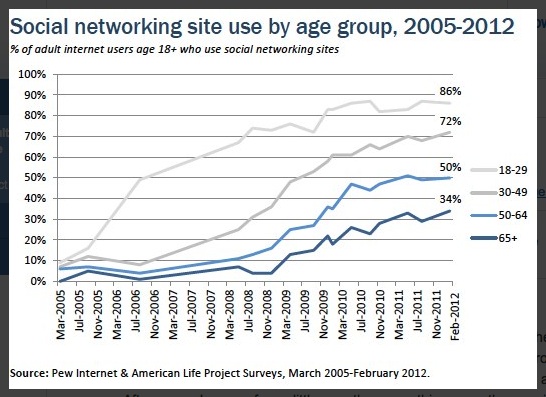
pew-internet-aging-social-networkingInterestingly, only a few years ago most seniors were satisfied with e-mail communication or the occasional video to watch. Not anymore. Today a growing number of people over 65 are enthusiastically latching on to social networking sites and using them on a fairly regular basis, and these numbers are growing.

This amazing graph depicts the percentage of adults at various ages who used social media sites over seven years, and it demonstrates how fast the use of these sites is increasing for all age groups, but especially for seniors.

Published in the Pew Internet’s July 2012 report on Older Adults and Internet Use, the information in the image comes from a Pew survey that collected data between March 2005 and February 2012.

Note the growth for the 50-64 age group and the over 65 age group (data that could hardly be detected back in 2005) over the years of the survey. Moreover, the social networking adoption percentage numbers for people 50 and older picked up a lot of steam, between July and November 2008.

Bottom line? Many more older adults are signing up and using social media sites, and their numbers are continuing to increase. One way that young family members can be especially helpful is to be on the lookout for seniors relatives who can use extra support as they learn more about living lives in the digital world.

The French essayist Joseph Joubert (1754-1824) wrote, “To teach is to learn twice.” Children relearn and review their own digital world lessons when they teach senior family members about learning and communicating in today’s always connected world. It doesn’t matter whether they are helping with privacy issues, teaching a senior to understand a cell phone, or demonstrating the many other virtual world tasks that a grandparent or elder relative might need to know. In helping that older family member learn something new, the child refocuses on the lesson.

That’s pretty cool for everyone involved.

Posted in digital citizenship, digital learning, digital parenting, family conversations, kids changing lives, parents and technology

8 Wishes Connected Kids Have For Their Parents

With more than 30 years as a teacher including over 20 in the educational technology field, I’ve heard many kids reflect thoughtfully, and not so thoughtfully, on their parents’ digital skills. Kids often wonder why parents don’t always model the digital citizenship expectations that they want their children to learn and apply.

I wish my parents wouldHere are the eight most common “I Wish” statements that I’ve heard expressed by children over the last 16 or 17 years. Two of them, I can report, my daughter also mentioned to me ages ago.

Kids Wish Their Parents and Other Adults Would

  1. Try to learn a lot more about computers in particular and technology in general.
  2. Stop saying they don’t know much about technology (mom’s especially)
  3. Do not use Blackberries and phones at sports games and school events
  4. Learn to play some of the kids’ online games.
  5. Understand more about helping with searches on the Internet.
  6. Understand how hard it is to learn the technology rules and regulations and not always threaten to take away technology access when there’s a problem.
  7. Stop automatically saying that new things like Wikipedia are questionable.
  8. Don’t act dumb about technology – act like you want to learn new things.
To learn a bit more read 4 Lessons for Parents in a Constantly Connected World over at the Mashable site.

Continue reading “8 Wishes Connected Kids Have For Their Parents”

Posted in 21st Century Learning, collaboration, digital learning, online research, parents and technology

Now This Is What You Want Connected Kids to Do!

geography-44729_640
Pixabay Public Domain Images

Sometimes when I sit quietly in a computer lab at school and observe my students, I overhear the most wonderful conversations about learning. Today, as I sat in a corner working quietly, several fifth-grade students came in and sat down to work on essays. Focused on work, they took little note of me.

A delightful conversation ensued when one student asked the other student for help with the name of a country. As soon as I realized that an interesting 21st Century learning conversation was happening, I started typing their dialogue rather than my parent letter.

The two children went online together, searched, made all sorts of comments and decisions about what they saw, discovered a few things that they were not looking for, and finally located the information that they needed. But their searching led to additional questions.

The entire conversation lasted less than two minutes, but they learned a great deal.

Student #1: I am trying to write about the country that broke off from India when India became independent. Do you know its name?

Student #2: I’m not sure. I know it’s right next door.

Student #1: Hummm. Maybe it’s Pakistan?  But I’m not sure.

Student #2: Maybe. Let’s go online and find a world map.

Student #1: OK. Are you going to Google it?

Student #2: Yes and look. If we go into Images there are lots of maps.

At this point the two students are both looking at dozens of world maps on Google Images and pointing at some of them. They talk about which map to look at. They choose one, but when the enlarge it, it doesn’t work.                  Continue reading “Now This Is What You Want Connected Kids to Do!”