Posted in 21st Century parenting, acceptable use, American Academy of Pediatrics, digital devices and gadgets, digital kids, parent child conversations, parents and technology

9 Suggestions to Help Families Think About Digital Device Moderation

Designed using images from the Apple website.

I love my iPhone and iPad, and I cannot do many things without them. For children under 13, however, use time should be carefully monitored by each family. Kids today are playing independently with powerful devices, and they — the devices and the children — are not intended to interact in isolation and for long periods without adult supervision.

An article that provides food for thought, Your Phone Versus Your Heart, appeared in the March 23, 2013 New York Times. Also, check out the American Academy of Pediatrics media resources — the pediatricians are making recommendations because they know what they are talking about.

Just today I asked a group of device-savvy fifth graders, most around age 10, if they know anything about SnapChat, the app that deletes pictures in one to ten seconds (leaving plenty of time for a recipient with poor judgment to take a screenshot and save the photo). Just about every hand went up. During a lesson a few months ago I asked them how many of them know how to make a screenshot — and they can all do it in a lot less than ten seconds. Read my SnapChat review here.

A Few Social Media Supervision Suggestions            Continue reading “9 Suggestions to Help Families Think About Digital Device Moderation”

Posted in 21st Century parenting, 21st Century teaching, digital citizenship, digital kids, ethical behavior, teaching digital kids, values in digital life

Beauty Contests? What Will It Take for Us to Really Lead Our Digital Kids?

socialmediakidsIt is a truth universally acknowledged that whenever a new technology feature comes into vogue, children and adolescents come into possession of digital skills in want of copious adult tutelage.

Or at least this should be universally acknowledged.

Just now, in my part of the world, we are in the midst of an Instagram beauty contest phase. Interestingly, however, parents and educators who have spent the past 10 years connected in any way to the teen-tween digital world will recognize that, at a minimum, this is actually beauty contest 3.0.

I recall two other student beauty contest episodes, each occurring on a different digital playground. Initially, they appeared on make-your-own websites, then on MySpace. Now we have Instagram.

As I said the other morning to a concerned mom, behaviors get recycled each time a neat new whiz-bang digital opportunity emerges. Typical kid behavior gets paired with a powerful app, but mostly without the benefit of that adult tutelage referred to above. Also, kids love contests so it’s natural that the idea comes up.

Children are growing up in two worlds. Families and schools now have two childhood environments to supervise —  face-to-face and the digital — and kids are learning and playing in two places, irrevocably intertwined. School and home guidance acclimate children mostly to the face-to-face world, assuming that the lessons automatically carry over to digital endeavors. They don’t.

Continue reading “Beauty Contests? What Will It Take for Us to Really Lead Our Digital Kids?”

Posted in advertising, American Academy of Pediatrics, digital kids, digital world conversations, media diet, media literacy, screen time

Advertising With Kids as Targets

For several months I’ve been carrying around a New York Times article, How Advertising Targets Our Children, from the February 11, 2013 edition. Written by pediatrician Perri Klass the Well Blog post points out that recently published research links, even more strongly, the exposure of alcohol advertising to a child’s movement toward unhealthy behaviors.

Health Children Media Ed
Check out the Media Resources at HealthyChildren.org.

Dr. Klass writes about Exposure to Alcohol Advertisements and Teenage Alcohol-Related Problems (abstract), a Pediatrics article describing new research that finds a stronger association between unhealthy behaviors and the amount of advertising in the lives of children and adolescents. The researchers followed nearly 4,000 children in grades seven through ten.

Read the full text of the Pediatrics article.

In her article Klass quotes the researchers, experts from the Yale Rudd Center for Food Policy, and pediatrics professors from the Children’s Hospital at Stanford University who have studied the links between childhood obesity and screen time.

Continue reading “Advertising With Kids as Targets”

Posted in 21st Century Learning, digital devices, digital devices and gadgets, digital kids, teaching, teens and technology, wireless gadgets

New Pew Report on Teens and Technology 2013

Growing internet use by teens and other age groups, too.

If you are an educator who teaches teenagers or a parent of adolescents, check out this newest research release — Teens and Technology, 2013 —  from the Pew Internet and American Life Project. The survey results come from interviews with 802 adolescents between the age of 12 – 17 and separate interviews with their parents, conducted over the phone in English and Spanish.

If you have any doubts about how fast digital life is changing for young people, this should dispel many of them.

  • 78% of teens now have a cell phone, and almost half (47%) of them own smartphones. That translates into 37% of all teens who have smartphones, up from just 23% in 2011.
  • 23% of teens have a tablet computer, a level comparable to the general adult population.
  • 95% of teens use the internet.
  • 93% of teens have a computer or have access to one at home. Seven in ten (71%) teens with home computer access say the laptop or desktop they use most often is one they share with other family members.
  • 25% say they mostly use their phone online.

Most Interesting Quote

One in four teens are “cell-mostly” internet users, who say they mostly go online using their phone and not using some other device such as a desktop or laptop computer.

Schools must find ways to incorporate phones into the 21 Century learning paradigm.

Posted in 21st Century Learning, collaboration, digital kids, digital parenting, extreme professional development, NAIS Conference Reports, parents and technology

Workshop Planning As Extreme Professional Development: My NAIS Conference #3

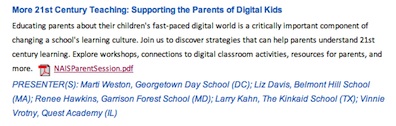
OurStoriesI’ve just returned from the 2013 National Association of Independent Schools (NAIS) annual conference, where I presented a workshop with three colleagues, Renee Hawkins, Vinnie Vrotny, and Larry Kahn. In our Thursday afternoon session we shared our ideas about coaching the parents of 21st Century learners to help them understand more about the digital lives of their children.

As I reflect on our wonderfully collaborative NAIS presentation project — coming up with an idea and developing it over time — I now understand that the workshop planning process led me and my colleagues on a substantial journey featuring what I think of as extremely connected professional development.

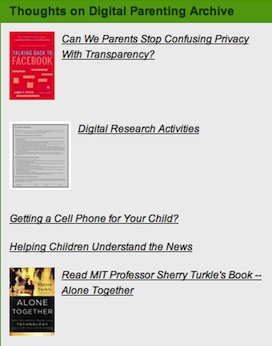
Thoughts on Digital Parenting
An example of digital parenting book resources

This workshop’s journey began a year ago at EdCampSeattle, where I shared an idea about the importance of educating 21st Century parents. At my school I work hard at educating parents about their digital kids, so I wanted to learn lots more about what my colleagues do at other schools.

Actually, I initially shared my idea with independent school colleague, Liz Davis, a dedicated EdCamp advocate, and she told me that I just had to attend EdCampSeattle. (Note: Liz is also one of the main people responsible for getting me to start blogging, but that’s another story.)

If you’ve attended EdCamp, you know that participants suggest lots of great ideas, but not everyone becomes part of the program. At the beginning of every EdCamp people walk around the room suggesting and choosing the topics they are most interested in — called the “law of two feet” in “EdCampSpeak.” They go on to experience, a day-long collegial event that they have planned, essentially carrying out their own program — in itself extreme professional development. Expanding this idea, my workshop colleague, Larry Kahn, will shortly experiment with inviting parents to attend an EdCamp along with teachers.

Continue reading “Workshop Planning As Extreme Professional Development: My NAIS Conference #3”

Posted in 21st Century Learning, digital citizenship, digital kids, digital learning, digital parenting, NAIS Conference Reports, parents and technology, social media, social media friends

Learning Lots More About Topics I Know Lots About: My NAIS 2013 Conference #1

You are in a good workshop when it’s on a topic that you know well, and you end up learning a whole lot more, and when you feel new knowledge pathways opening up, you say “Wow!”  That’s what happened to me on Friday morning at the 2013 National Association of Independent Schools (NAIS) annual conference, this year in Philadelphia.

I attended a workshop, “It’s Just Facebook: Ethical Questions in Social Media Use,” and discovered first-hand how much I can still learn about educating children, their parents, and educators when it comes to 21st Century digital citizenship and media literacy problem-solving. What’s  especially interesting to me since, just the day before, I presented a workshop with three of my NAIS colleagues on a similar topic.

Ethics institute
Check out the Ethics Institute teacher workshops.

In their “Ethical Questions” workshop, Kent Place School presenters Kimberly Coelho and Karen Rezach helped us compare moral with ethical dilemmas sharing case studies that are designed to help students examine and address the life challenges that pop up in their 21st Century learning and digital lives.

The two leaders, part of the Ethics Institute at Kent Place, walked us through the discussion process, emphasizing how they  include a range of different perspectives. Often right and wrong answers are not so clear because the dilemmas usually present competing values, so the problems are not examined or solved easily.

Continue reading “Learning Lots More About Topics I Know Lots About: My NAIS 2013 Conference #1”