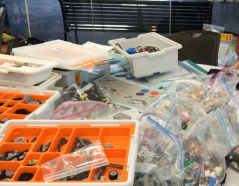
A maker table filled with supplies to help innovate and solve problems at the Constructing Modern Language conference that I attended in July 2014.
If you want a perfect example of people coming together — as makers — to work on a critical and life-saving project read the article How a Wedding Dress Maker is Trying to Stop the Spread of Ebola, in the Washington Post. The November 9, 2014 article describes how John Hopkins University biomedical engineers brought together a group of people to generate ideas about how to make a safer and more comfortable protective suit for the medical personnel who care for Ebola patients.
Last year, after a lesson comparing formal and informal online writing, I asked GDS fifth graders to reflect on what they had learned. We also discussed the effect writing can have on a reading audience and the conclusions a reader just might form about a writer. To learn a bit about what we did, you can read my lesson overview, Writing Online — What to Think About.
Below are some student contributions to the conversation, written in response to my post on their fifth grade blog. These 21st Century learners understand the differences between various types of writing – but they need adult help when it comes to applying what they know as much as possible and adult commendation when they get it right. Parents of digital kids — take note.
I am learning how to code, and right now it’s hard. With all of the talk about teaching children to code — I agree, but sometimes the world of education goes overboard on our newly recognized philosophies — I decided to organize a small before-school activity using MIT’s Scratch coding site. There was only one problem with my program idea. I only knew a little bit about Scratch.
So I started the morning activity during the second week of school and by day two, a few of the 10-15 attendees (children in grades 3-5) were ahead of me. “What’s a variable?” one of them asked. “Do you know how to make a game where the sprite (the little person on the screen who carries out the coding commands) bumps into a ball?” asked another. My answer in both cases was no. Sure I knew how to do many beginning tasks in Scratch, but not what these children wanted to know.
Now those of you readers who are educators and parents know that kids often take care of things like this by figuring out things for themselves — and my students did just that, experimenting and trying things out — but I wondered, “If these questions were coming up on the second day, what would the second week be like?” I needed to master some new Scratch skills and fast. Continue reading “Learning How to Code: Relearning How to Learn – Report #1”→
Now that we are all returning to school routines, take the time to make a few 21st Century family decisions — choices that can help the device-users in your family grow more careful, thoughtful, and serious about their connected world responsibilities. With so much going on the digital world, parenting today is a bit like riding a roller coaster. But some carefully considered decisions can set the stage for fewer digital world scrapes and bumps in a family’s life.
1. Where will digital devices be charged at night? Most educators recommend that families charge devices in a centralized location away from bedrooms. Many parents also set an evening time limit after which mobile phones, iPads, and even the Internet cannot be used.
2. If students have significant amounts of online homework, where will they work? Dining room table? Family room? Den? Most educators and pediatricians suggest that students do homework on computers that are located in places where other people also spend time and not in the bedroom. Check out How Does Multitasking Change the Way Kids Learn over at the KQED Mindshift website.
The word order of a search matters in today’s connected world, so 21st Century learners — of all ages — should understand how search results change when a user rearranges the words. A short video on word order, uploaded by Google’s Search Anthropologist Daniel Russell – check out his Search-Research blog – teaches this lesson effectively.
Use this less-than-two-minute video — I found it in a blog post at Free Technology for Teachers — as a quick and succinct teaching tool with students, parents, and other educators.
As we get ready to return to school for the 2014-15 academic year, my thoughts turn toward the digital life changes that I’ll observe in the lives of my 21st Century students when we come together in September.
After three months of summer activities such as volunteering or part-time jobs and the less structured time at camps and on vacations, most kids arrive at school with new digital experiences, devices, and apps — and they want to share everything. I’ve especially thought about the number of apps that seem to come out of nowhere — suddenly appearing in kids lives and on their mobile devices — and I know popular new ones will appear this fall.
Below I am sharing three slides from digital parenting presentations that I made over six months, from October to May during the 2013-14 school year.
Invent to Learn Graphic Art. Click to check out the book.
As my learning activities continue at the 2014 Constructing Modern Knowledge summer institute (CMK14) I’ve spent a significant amount of time thinking about young 21st Century connected learners who come to our classrooms with special talents or unusual interests.
Often our classes include students who discover especially interesting topics, and these kids learn more and more until they develop expertise in the area. Sometimes the students go even farther with a subject, developing a passion and spending enormous amounts of personal time looking for more to learn. Last year at my school a fifth grader demonstrated, over and over, his passion for aviation and his all-consuming interest continues to thrive.



 Media! Tech! Parenting!
You must be logged in to post a comment.