Writer Christina DesMarais describes a study that identifies irritating digital world behaviors such as communicating at inappropriate times, sharing too much information, and highly negative commenting — all related to our increasing use of 21st Century social media.
This article is filled with digital world conversation starters that parents and teachers can use to begin discussions about ethics, privacy, and security.
Our digital society hasn’t figured out what to do about privacy. More importantly, it hasn’t figured what to do about the privacy of our kids — we keep confusing privacy with transparency.
It’s problematic enough that adults are diving willy-nilly into the digital world, sharing everything about themselves, private and not so private, but it’s even worse to observe a world where everything a child does and almost every mistake he or she makes is now public. These days we are giving children and adolescents no cover and no protection as they blithely explore the digital world while making what in any other era would be common and developmentally appropriate errors.
Lest I sound like a digital Luddite, I’m not. I love participating in the activities of my digital world, actively but moderately, and I have an arsenal of digital gadgets in my purse, book bag, and lying around my house. As an educator, however, I am keenly aware of how much we are forgetting to nurture and honor kids’ developmental stages as they grow up in this digitally dense world. Part of solving that problem involves ensuring that children have a guaranteed amount of privacy.
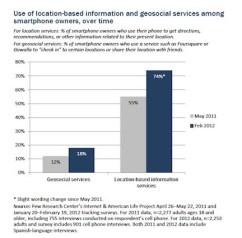
The Pew Internet & American Life Project has just published new survey results finding that 74% of smartphone owners — that’s three-quarters — appear to be using location services on their phones.
This statistic is double what it was when Pew conducted a similar survey in May 2011. The increase in location services occurs despite privacy concerns about tracking and data collection. Check out the report to look at the data by age, gender, and ethnic group, depicted in a range of charts and graphs.
I am still minimizing or turning off the number of location services that I use on my phone. While some of us use more location services than others on our smartphones, it’s critical for parents to know how location services work and how to limit access on the phones that their children around each day. Many apps ask to turn on location services during the installation process.
Do you know about Foursquare ? If it’s on an adolescent’s cell phone a parent needs to learn about it. Find out more about location services by reading a post that I wrote about location services, Location, Location, Location – Services that Is.
Each adult needs to figure out how much privacy is necessary or desired in his or her digital life and also in the digital lives of children. People seeking one right answer won’t find it, however, it’s best to take the time to understand the devices that family members carry and apps that they use.
One of my sunflower pictures with words added for a presentation on professional development.
I have a new favorite app — Wordfoto. Interestingly it’s designed for an iPhone but does not yet have an iPad version.
With the Wordfoto application, I make a word list and then have some fun designing art. I select a picture as a background to highlight my words. I can use an image that comes with the app, I can use one of the pictures in my iPhone photo galleries, or I can take a new picture.
When I combine the picture and the word list — voila, a cool Wordfoto. The app comes with a variety of editing options, allowing users to play with the image, crop it, create styles, and fine tune the texture of the pictures. Wordfoto also comes with preset styles that introduce texture, color, and depth variations, making it easy for new users to get started.
Newly created images can be easily e-mailed, posted to Facebook, and more. Once e-mailed, the Wordfoto jpg images can be incorporated into other projects.
Potential uses? Spelling lists, messages and cards, vocabulary practice, event signs, and much more. The images will also be useful as illustrations for school reports, and I’m excited because I design occasional images for my blog posts.
Over the past 10 days I have attended multiple, jam-packed professional development events. I’m beginning to think of it in reality show lingo as my extreme professional development experience, because I’ve encountered so many colleagues along with ideas, hands-on strategies, learning theories, and thoughtful approaches, all focused on becoming better teachers, collaborators, and learners in the 21st Century. One over-arching idea applies to all of my activities: learning, unlearning, and relearning are now routine. Anyone not comfortable with these three concepts — connected and in tandem — needs to get acquainted with them ASAP.
I’m reminded of a quote from futurist Alvin Toffler, “The illiterate of the future are not those that cannot read or write. They are those that can not learn, unlearn, and relearn.“
My extreme adventure started about 10 days ago when I presented in the Virginia Shenandoah Valley at the Virginia Association of Press Women. I described how technology has transformed the way we all learn and how specific content is now less important than our skill at discovering information, evaluating it, and using it well. The digital content is out there for everyone to find, I told the group. The role of adults and teachers is to ensure that as we teach one area of content we also ensure that children are developing the skills to recognize, evaluate, and use quality information.
I drove home on Saturday and left again on Sunday for the annual AIMS Technology Retreat on the Maryland Eastern Shore.
Today, as everyone is talking about the public stock offering and it’s worth, writer Taso Legos examines the value of Facebook as a societal public space that enables people to share ideas and speak up. Without a doubt, face-to-face communication is occurring less and less in coffee houses and community centers, but we are all aware of that aspect of our 21st Century virtual world communication bargain.
I wonder, though, about what is the best balance between face-to-face and electronic communication — the best to ensure a vibrant democratic process. It’s up to parents and teachers of digital kids to help identify the right balance.
Most Interesting Quotes
We engage more in the public sphere because it has never been easier to do so.
… the new electronic public sphere offers instantaneous dialogue with little time for reflection. Democracy is thus now on steroids and this speeding up affects how we make decisions.
Summer is the time when many digital children start using e-mail accounts — and often the laid back summer lifestyle means that parents spend less time helping their children develop strong and collaborative digital habits.
Last year’s post offers parents some ideas and suggestions for getting started and setting limits.
Hundreds of digital options — e-mail is only one of them — are available and waiting for your child to discover them, so in the final analysis you cannot prevent digital access. You can, however, make decisions help you focus on educating your child about digital citizenship.

 Check out the May 13, 2012 post, Online Etiquette Lacking, Study Finds, over at the Techlicious blog.




 Media! Tech! Parenting!
You must be logged in to post a comment.