Posted in 21st Century Learning, digital devices and gadgets, parents and technology, social networking, when kids make mistakes, when to give children email

Your Brain is the Final Spell Checker!

The process of spell checking is a two-part endeavor, and it’s an important digital world lesson for everyone — kids and adults — to master.

Part one features the work of the computer or website, as the spell check program goes to work. But after the digital spell check process a bigger responsibility lies ahead.

Each time a person writes and rewrites, he or she must spell check the spell checker — an important 21st Century skill. And while a commitment to differentiated instruction requires teachers and parents to recognize that some writers will be better at this second step than others, all students need to understand that the digital editing process cannot identify every mistake.

This poem always makes the point effectively with my students. Use it as a great conversation piece (and also to review homonyms) — over 2012 Easter and Passover dinner tables or any other time.

And if you put the words of this poem into Google search, you’ll discover that there are many other versions.


Human Brain Not Yet Obsolete

I have a spelling checker.

It came with my PC:

It plainly marked four my revue   Continue reading “Your Brain is the Final Spell Checker!”

Posted in cell phones, communicating with grandparents, family conversations, gadget ownership, online communication

Grandma’s iPhone

Over Easter weekend we’ll help my parents learn how to use Skype.

When it comes to her iPhone, few learning difficulties have popped up for my mom, age 84. I am delighted at the ease with which she has transferred from her old flip phone to this one — a 3G that I retired when I updated my iPhone.

How Mom is Using her iPhone

  • Her first lesson focused on typing in her contacts, and she caught on right away and also understands how to make a call using the contacts app.
  • The visual cues on the iPhone screen are terrific.
  • She loves being able to sit in a comfortable chair and play solitaire — no lessons required for this!
  • She enjoys using the speaker feature rather than holding the phone up to her ear.
  • She likes to use Safari anytime and anywhere when she wants to look something up, though like me, she is sometimes frustrated when the phone is slower because there is no wi-fi.
  • She is starting to use the map app.

Continue reading “Grandma’s iPhone”

Posted in cultural changes, digital parenting, parent child conversations, parents and technology

Staying Power — Is there Such a Thing Anymore?

My First Palm (PDA)

I’ve been thinking a lot about staying power and about the importance of understanding just how fast things can change in the digital world. Both are great topics for family conversations about 21st Century life.

My Current iPhone 4S

In Bye Bye BlackBerry. How Long Will Apple Last? Forbes writer Adam Thierer describes a historical pattern — digital information giants rising and eventually declining when something better, more interesting, and useful comes along.

Using Blackberry as the current example, with occasional references to Palm devices, Thierer points out that these companies are classic examples of companies, “… with a static snapshot mentality disregarding the potential for new entry and technological disruption.”

I’ve never owned a personal computer other than a Mac, so I understand a lot about rising and falling fortunes and how Apple is currently riding high. I also, fondly remember my first Palm device and how revolutionary it seemed.

Still, it’s interesting to think about what new and exiting gizmos may be residing in someone’s garage, basement, hard drive — or imagination — and how revolutionary they may seem compared to the products we love right now.

Posted in cell phones, digital learning, digital parenting, electronic communication, online communication, parent child conversations, parents and technology

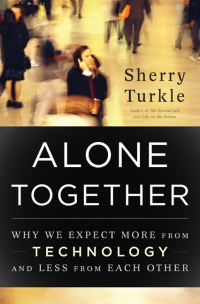
Sherry Turkle TED Lecture-Connected but Alone?

The TED Talk site just posted the most recent lecture by MIT professor and psychologist Sherry Turkle. It’s embedded below.

In her presentation, Professor Turkle illustrates several of the most compelling issues from her recent book, Alone Together. She points out that technology may give us an illusion of togetherness with others, but she challenges us to understand that digital connectedness is not a substitute for person-to-person interaction.

  • Are we hiding from each other even as we are connected?
  • With fewer face-to-face conversations with one another are we less able to learn how to have conversations with ourselves?
  • Do feelings that no one is really listening to us make us want to spend more time with machines that make us feel like these devices are listening to us?
  • Are people increasingly willing to settle for the pretend empathy of devices and robots?

Continue reading “Sherry Turkle TED Lecture-Connected but Alone?”