Posted in digital parenting, family conversations, media literacy, parents and technology, social media, social networking, teens and technology

Pew Report on Teen Behavior and Social Media Sites

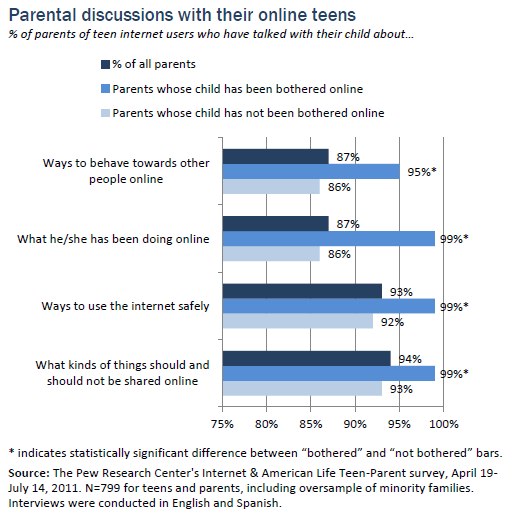
Pew infographic. Click and view larger version of this image.

Take a few minutes to read at least the main points of the November 2011 report on teens and social networking, published in November 2011 by the Pew Internet and American Life Project. The executive summary is a fairly quick read.

During the spring and summer of 2011 researchers made calls to 799 teens between the ages of 12 and 17, and they also spoke with a parent or guardian of each adolescent. Interestingly, a large number of the teens surveyed reported that their parents and teachers provided them with the best and most helpful advice on digital citizenship issues and other virtual concerns. The media were the third most significant influence.

Browse all of the infographics from this Pew Internet report.

A Few Other Interesting Points

Continue reading “Pew Report on Teen Behavior and Social Media Sites”

Posted in digital parenting, parents and technology, social media, social media friends, social networking

Redefining Public Relations in Our Digital World

Check out this article about social media at Wikipedia.

If you wonder about the still-new world of social media, and are continually amazed when a few comments on a social media site affect prompt change  (whether it’s a political movement, corporate policy, or an unsatisfied customer quieted down) this New York Times article, Redefining Public Relations in the Age of Social Mediaprovides helpful background. The article, by Stuart Elliott, describes the evolutionary and revolutionary changes in the digital public relations world.

A Few Interesting Thoughts from the Article

Posted in parents and technology, research on the web, social media, social media friends, social networking

Communicating on Social Media: As American as Apple Pie?

Check out the full report at http://bit.ly/vNhmnw

The Pew Internet and American Life Project recently published new social media data, this time asking why American adults use social networks.

From my point of view, keeping in touch with people is a grand old American tradition, as traditional as apple pie. Over the years whether it’s over the backyard fence, via snail mail letter, postcard, telephone, or e-mail, Americans like to connect and communicate.

Interestingly, according to this new Pew data, adults become involved with social media — Facebook, Twitter, Linkedin, and others — because of the ease of keeping in touch. People use a social medium if it makes communicating with friends and family easy and fun.

Moreover, users like that social media now offers faster and faster ways to reconnect with the people from the past — something that was far more difficult in the “olden days.”

Posted in digital citizenship, digital parenting, electronic communication, media literacy, parents and technology, social media, social networking

Young Social Media Users Support the First Amendment

Click to view this image, by Column Five Media, depicting survey results.

Via Milwaukee Journal Online, an interesting article, As Social Media Grow, So Does First Amendment Appreciationdescribes research conducted by the John S. and James L. Knight Foundation. The foundation has taken four surveys, beginning in 2001, to learn more about what high school students know and understand about the First Amendment of the Constitution. (Read the First Amendment here.) The Knight Foundation website explains how that group got started with this work

… after surveys of American adults conducted by The Freedom Forum showed that even modern-day support for the First Amendment is neither universal nor stable. In the wake of the 2001 terrorist attacks, support for the First Amendment plummeted. Suddenly,  the nation was almost evenly split on the question of whether or not the First Amendment “goes too far in the rights it guarantees.’’ Continue reading “Young Social Media Users Support the First Amendment”

Posted in digital parenting, museums, parents and technology, social media, social networking

Social Media and Great Leadership

Figuring out how to interact with and use digital media gracefully is a challenge for many adults. A day doesn’t pass that I don’t hear adults express some degree of despair about social media and how it relates to the education of their children.

Visit the museum.

So it was with some interest that I read an article, Museum Displays an Educator’s Philosophy, in the September 9, 2011 Washington Post, an interview with educator Johnnetta Cole, Ph.D., who shares thoughtful comments about social media. An anthropologist, college professor, and former president of two colleges (Bennett College for Women and Spelman College), Cole, age 74, is now the director of the National Museum of African Art in Washington, DC. As a leader, she demonstrates creativity and passion for the museum while developing programs that reach out to communities, and she promotes the museum’s educational activities. Using social media wisely is a part of the museum’s plan. Read Cole’s Smithsonian bio.

Continue reading “Social Media and Great Leadership”

Posted in digital parenting, parent child conversations, parent education, parents and technology, social media, social networking

Learning More About What You Don’t Know

I am just back from a huge technology conference in Philadelphia, the International Society for Technology in Education(ISTE), and I blogged from the event uploading nine or ten entries on a separate MediaTechParenting page. I also tweeted — sometimes using Twitter myself and at other times just watching, reading, and processing the tweets of others.

During the week — before, during, and after the conference — Twitter was my most important communication too. Over the four days it let me know where especially great workshops and presentations were occurring, helped me discover other people who shared my interest, kept me up-to-date about who was blogging, informed me about presenters who were sharing resources beyond their presentation rooms, and yes, even announced the location of the special snacks each afternoon. Without the #ISTE11 Twitter handle, and also the continuing backchannel tweets on #edtech and #edchat, my week would have been slower, less interesting, and nowhere near as dynamic.

Continue reading “Learning More About What You Don’t Know”

Posted in digital parenting, online security, parents and technology, privacy, social media, social networking

Best Instructions for Disabling Facebook Facial Recognition Feature

Facebook has tossed out another challenge to family members, including grandparents, who seek to maintain privacy while still enjoying the social interaction that the social network offers.

Here we go again with facial recognition.

Find instructions for disabling the new Facebook facial feature at the BBC blog, WebWise: A Beginner’s Guide to Using the Internet. I’ve compiled the basic steps after reading a number of posts about the new facial recognition additionbut read the whole BBC post for the simplest and most comprehensive explanation.

  • Go to Account.
  • Go to Privacy Settings.
  • Click on Customize Settings (itty-bitty blue link at the bottom).
  • Find the category, Things Others Share.
  • Find the words Suggest photos of me to friends and click the edit settings button.
  • Naturally…Facebook’s default has enabled the feature so you want to click on the button that disables the feature.
  • Click OK.

Continue reading “Best Instructions for Disabling Facebook Facial Recognition Feature”
