Posted in blogging, choosing reliable resources, digital learning, digital parenting, digital photography, parents and technology, teaching digital kids

Hurricane Sandy: Finding Reliable Information That Helps You Learn as Well as Look

When a super storm event like Hurricane Sandy occurs, digital kids and their families get a good, and sometimes sobering opportunity to learn a lot more about the work of journalists — professional and citizen — as well as first responders. Much suffering, as well as amazing feats of service to others, occur during these events, so it’s important to view and consume the most authentic of resources available.

Hurricane Sandy damaged the
Ocean Grove Great Auditorium.
Photo by Paul Goldfinger  and Blogfinger.net. Used with permission.

Lots of Hurricane Sandy coverage can be found in newspapers, blogs, and other social media, offering us opportunities learn together as families — as we share the content about the storm, the terrible damage it caused, and the ways that people responded. Children and adults will also use these resources in the coming days to figure out how to help, and in the process we all strengthen our media literacy skills (important in today’s world) by identifying the best and most reliable sources of information.

The other day I discovered an amazing blog as I searched for coverage of the storm and its effects on Ocean Grove, New Jersey (where I spent many happy summers as a child). Run by Paul Goldfinger and colleagues, Blogfinger.net offers me on-the-scene hurricane reports from the little beach town, so dear to me and my family, and now without its own newspaper.

Blogfinger — I discovered it thanks to my cousin, also know as Sandy — turned out to be a terrific resource. It has solid  information, great pictures, and well-written narrative. The picture to the right, shows the damage to the Great Auditorium, a structure listed on the National Register of Historic Places, and a place where I’ve attended dozens of worship services and concerts. You can check out many other Ocean Grove photographs at the Blogfinger site.

One does not need to look far, however, to find examples of unreliable sources.                 Continue reading “Hurricane Sandy: Finding Reliable Information That Helps You Learn as Well as Look”

Posted in parents and technology

New Common Sense Media App-Free Mobile Movie Reviews and Ratings

Click to visit iTunes and learn more about the new Common Sense Media app.

Today Common Sense Media (CSM) announced the release of a new mobile app for families. This new app offers the organization’s reliable ratings and well-written website reviews in a new format that can be easily accessed on mobile devices.

Freely available from iTunes, the new CSM app will make it easy for parents to pull out their iPhones and learn more about movies — even when they are away from home and on the go.

An Android version of the app will be available in November 2012.

Read the information on the image to the left of this post, click on it to visit the iTunes store, and learn lots more. You can also read the October 24, 2012 Common Sense Media press release for more details about the new app.

If you are unfamiliar with Common Sense Media, take a few minutes to learn more by visiting the organization’s website.

A May 2012 post on this blog, 10 Simple Steps to Internet Safety, shared another Common Sense Media online resource.

Posted in 21st century job hunting, digital change, digital parenting, family conversations, generating content, parents and technology, social media, social networking

Just How Much Social Media Is There?

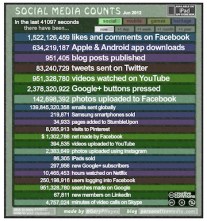
Click on the image to visit Gary’s Social Media Counter.

Have you ever wondered about how much social media interaction occurs in the digital world at any given point in time? Recently I discovered an excellent social media teaching and learning tool that helps people gaze into the always-changing world of social media content.

Over at PersonalizedMedia.com, blogger Gary P. Hayes offer a living widget with algorithms that track the approximate number of interactions in a range of social media categories — all in real time. He’s also turned his counter into an iPad app.

Visit Social Media Counts — a living statistical chart originally published in 2009 but upgraded in 2011 and 2012 — and start counting the moment you open the page. The site offers a progressive snapshot of what’s occurring in the social media universe as time moves along. It continues counting until a visitor closes the web page, and it starts counting again if the page is reloaded or if a user clicks the “now button.”

Leave the page up on your browser, come back a while later, and gaze in wonder at the growing statistics. Users can also click on the day, week, or month buttons to see different, and more massive social media statistics.

Continue reading “Just How Much Social Media Is There?”

Posted in cultural changes, digital change, digital parenting, future of the Internet, online communication, parents and technology, social media, social media friends, social networking

Looking into Our Kids’ Futures: Will Social Media Be There?

If you missed this set of essays, Is Facebook a Fad? Will Our Children Tweet?, published in the June 19, 2012, New York Times, take some time to read these short pieces on social media and contemporary life.

As a part of a regular Times’ feature, Room for Debate opinion, readers can learn what six knowledgeable media commentators think about the always evolving digital world.

For instance, MIT Professor Sherry Turkle describes the tendency of social media users to “hide” from one another, substituting quick text nuggets for what used to be face-to-face interaction. Morra Aarons Mele, a digital manager and founder of Women Online, acknowledges the communication downsides, but says that social media and the digital professional work it has created make the world more egalitarian.           Continue reading “Looking into Our Kids’ Futures: Will Social Media Be There?”

Posted in 21st Century Learning, digital learning, digital parenting, family conversations, online learning, parents and technology

Helping Children Navigate Digital Streets: Ideas for Parents (and Teachers, Too)

Several times recently I’ve mentioned a colleague’s blog post, A Letter to Parents of Digital-Age Students. Published at Getting Smart, this piece is so good that I’ve already shared it with half-a-dozen colleagues and handed it to several parents at my school.

Read the post.

Susan Lucille Davis, a colleague of mine and — lucky for me — a member of my personal learning network, writes about the strategies that we adults must use if we want our children to become savvy and safe digital consumers. The task for adults, whether we know a lot or a little about technology, is to support, guide, and help children as they go about learning to manage the challenges in today’s digital world. We must be adult trail guides.

While Susan Davis directs her post primarily toward parents, educators can also take her information to heart.

Three Important Points in this Article                            Continue reading “Helping Children Navigate Digital Streets: Ideas for Parents (and Teachers, Too)”

Posted in 21st Century Learning, digital citizenship, digital parenting, online safety, parent child conversations, parents and technology, teaching digital kids

Seeking a Family Digital Use Agreement or Contract?

Check out the GetNetWise family digital use agreements.

Many times each year parents and teachers ask me for examples of agreements and contracts that can help families focus on digital life expectations and limits-setting. Some individuals seek a pre-written document to use with their children, while others hope to design and write a document expressly for their families.

These agreements, contracts, or pledges, cover the gamut of 21st Century digital world behavior, from cell phones, to online access, to texting, web 2.0, social media, cyber-bullying, and digital citizenship.

The conversation and preparation that contribute to developing a family agreement or contract are often more important than the final document. In these family discussions, parents will need to arm themselves with information about digital natives, address values, and encourage common sense. Parents will also need to help their children think about what to do in unexpected situations, and encourage them to speculate on how to cope with friends who encourage them to misbehave. The more personal and relevant the agreement, the better.

Then, too, adults should understand that the preparation and writing process is not a one-way street. A child may make a pointed observation or come up with a thoughtful idea about the digital issues contained in the agreement. Perhaps he or she feels strongly about certain types of access, time limits, or other parental expectation.  Maybe there are compelling reasons to grant access to one site or another, even though the parent has reservations.

Continue reading “Seeking a Family Digital Use Agreement or Contract?”

Posted in digital footprints, digital parenting, Do Not Track Kids Act, online security, online tracking, privacy

Stop Tracking Kids: Protect Their Privacy on the Web

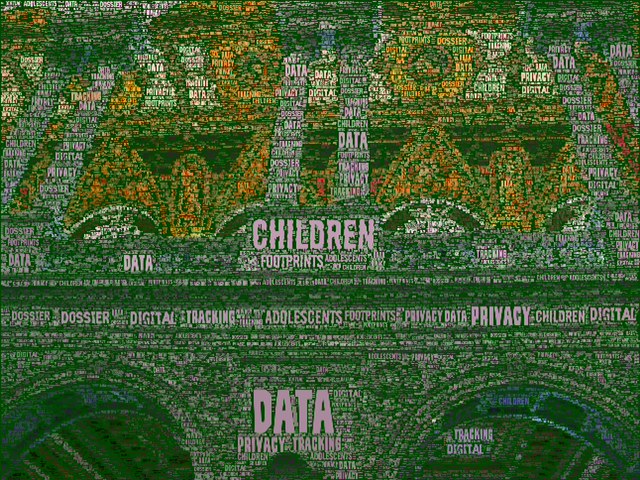
Image made with WordFoto with a picture taken at the Library of Congress.

While people worry a lot about kids and their digital access, the most critical aspect to me — and the most likely to cause an eventual problem for a child — is the degree to which information can be tracked and collected while children work and play in the web.

It doesn’t have to be this way.

For more information, read Tell the FTC to Stand Up for Children’s Privacy at the Campaign for a Commercial-Free Childhood website.