Posted in attributing sources, digital learning, digital parenting, Evaluating Web Resources, interesting research, research on the web

Kids and Web Resource Credibility

If you find yourself thinking about the digital research activities of children, especially older students who complete significant amounts of their research using the unlimited resources available on the World Wide Web, you are not alone. Over the past 10 years I have wondered — more than once and sometimes with great angst — if my child and the many children I’ve known really understand the need to evaluate the resources that they find on the web.

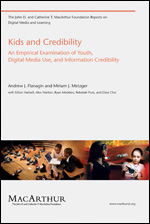
Earlier this year I discovered a small book, published by the MacArthur Foundation, describing research that explored how children perceive the quality and reliability of digital media. It’s a book that concerned parents may want to read. In Kids and Credibility: An Empirical Examination of Youth, Digital Media Use, and Information Credibility, authors Andrew J. Flanagin and Miriam J. Metzger, summarize their study as a “…comprehensive investigation into youth’s Internet use and their assessment of the credibility of online information.” The authors wondered whether young digital media users, while sophisticated and fearless about using technology, could evaluate information and determine its quality.

To learn more about young people and web credibility the researchers planned and executed a web-based survey of more than 2,000 children age 11 – 18. Study participants also completed a range of Internet tasks, evaluating information, making judgements about content, and explaining how and why they complete web tasks in certain ways. While there is far too much to cover in one blog post — check out the many interesting graphs in the publication — I’ve listed a few of the most interesting observations below. Continue reading “Kids and Web Resource Credibility”

Posted in cyber-bullying, digital devices and gadgets, digital downloading, Evaluating Web Resources

Terms of Use, Readability, and Digital Kids

Check the terms of use readability level at your favorite sites.

Just about every time I head over to iTunes to purchase something, I’m all set to finish up when the site diverts me to a change in the terms of use. It happens at lots of sites.  And each time I click to look at a site’s terms of use, it’s a longer document — 40 pages, 41, 42… Now I don’t object to changes or even insisting that users check things out, but terms of use are abstract and arcane and not especially easy to read or even understand.

I’ve always thought it would be an interesting conversation topic for parents and kids — taking a few minutes to look at those terms of use statements that most people accept and go right by, and helping children discover a bit about the fine print.

About eight months ago, I read a posting about terms of use documents, C’mon! Match Terms of Use Text to Users’ Comprehension Level, written by Linda Criddle over at the I look Both Ways blog.

Criddle described her experience examining terms of use documents posted on well-known and popular websites. She looked over the terms of use documents for the sites such as the New York Times, Amazon, iPhone, Club Penguin. Then she ran each document through a readability index – a tool that examines a passage and estimates how easy or hard it will be for a person to read the words, as well as what level of education the reader might need to comprehend the information. Continue reading “Terms of Use, Readability, and Digital Kids”

Posted in digital parenting, electronic communication, parents and technology, privacy

Online Privacy for Kids: FTC Requests Comments

FCC, another agency, provides this publication on net safety, and privacy. (Free)

Parents of digital kids will want to keep abreast of proposed Federal Trade Commission (FTC) revisions to online privacy regulations that, if implemented, would increase and expand online privacy protections for children. The changes will alter the  Children’s Online Privacy Protection Act (COPPA).

A September 16, 2011 press release from the FTC announces the proposed regulation changes and seeks comments from the public. The increasing use of mobile devices by children is one reason the agency believes that changes are necessary, and the expanded regulations would add locational data as additional personal information that needs to be protected.

Three Proposed Changes

1. Notify parents in advance if their children’s personal information is collected and may be used or sold.

2. Encourage the development of better parental consent methods, using any  developing technology that might improve how parents are contacted and ask for consent. Stop using the e-mail-confirmation method. Continue reading “Online Privacy for Kids: FTC Requests Comments”

Posted in digital learning, digital parenting, online research, parents and technology

Common Sense Media — Research for Kids

Common Sense Media recently published a solid piece aimed at helping parents and kids refine and strengthen digital research skills.

Teach Your Kids the Secrets of Smart Web Searching focuses on good research practices, with tips on how to search effectively and and explanations about why it matters. This piece can help parents stay front and center, guiding their kids (and themselves) on the road to becoming stronger digital information consumers.

Also included are a few Google tips  — ideas that can help Google work for the learner rather than the other way around.

Also check out a post from this blog, How Much Does Your Child Search Links?

Posted in digital citizenship, digital parenting, electronic communication, media literacy, parents and technology, social media, social networking

Young Social Media Users Support the First Amendment

Click to view this image, by Column Five Media, depicting survey results.

Via Milwaukee Journal Online, an interesting article, As Social Media Grow, So Does First Amendment Appreciationdescribes research conducted by the John S. and James L. Knight Foundation. The foundation has taken four surveys, beginning in 2001, to learn more about what high school students know and understand about the First Amendment of the Constitution. (Read the First Amendment here.) The Knight Foundation website explains how that group got started with this work

… after surveys of American adults conducted by The Freedom Forum showed that even modern-day support for the First Amendment is neither universal nor stable. In the wake of the 2001 terrorist attacks, support for the First Amendment plummeted. Suddenly,  the nation was almost evenly split on the question of whether or not the First Amendment “goes too far in the rights it guarantees.’’ Continue reading “Young Social Media Users Support the First Amendment”

Posted in Back-to-school digital reading, digital learning, Evaluating Web Resources, online research, parents and technology, supervising kids

Websites: Reliable or Bogus?

When we adults were students, we learned to write content-filled essays and reports, introducing the important facts about a subject. We discovered these facts by using quality reference materials, often at a library.

With today’s digitized resources and websites, a student follows roughly the same routine, but resource reliability is a significant issue. While it’s easy to find sites with information about a topic, identifying reliable and significant information is more of a challenge. The trick is to discover whether or not a site is a reliable resource.

Help your child determine the quality and reliability of a site before using it as a digital resource. The University of Maryland posts this short handout that explains how to go about evaluating a website.

Many sites appear to be real as well as reliable, but they are bogusAn entertaining website for you and your child to explore features bogus websites designed to look accurate and authoritative. Except that they aren’t. Take a few minutes to explore these bogus sites.

Better yet, explore them with your children.

Posted in cultural changes, digital citizenship, digital parenting, family conversations, gadget ownership, parents and technology

Digital Kids to Parents: Please Learn More…

With more than 30 years as a teacher including over 20 in the educational technology field, I’ve heard many kids reflect thoughtfully, and not so thoughtfully, on their parents’ digital skills.

Here are the seven most common “I Wish” statements that I’ve heard expressed by children over the last 16 or 17 years. Two of them my daughter told me.

Kids wish their parents and other adults would:

Continue reading “Digital Kids to Parents: Please Learn More…”